The Boat Beats the BTS: Why Bangkok Commuters Are Quietly Switching to the Canals
Gridlocked roads are pushing Bangkok commuters back onto the khlong network — the diesel boats on Khlong Saen Saep and the electric ferries now running the Chao Phraya.
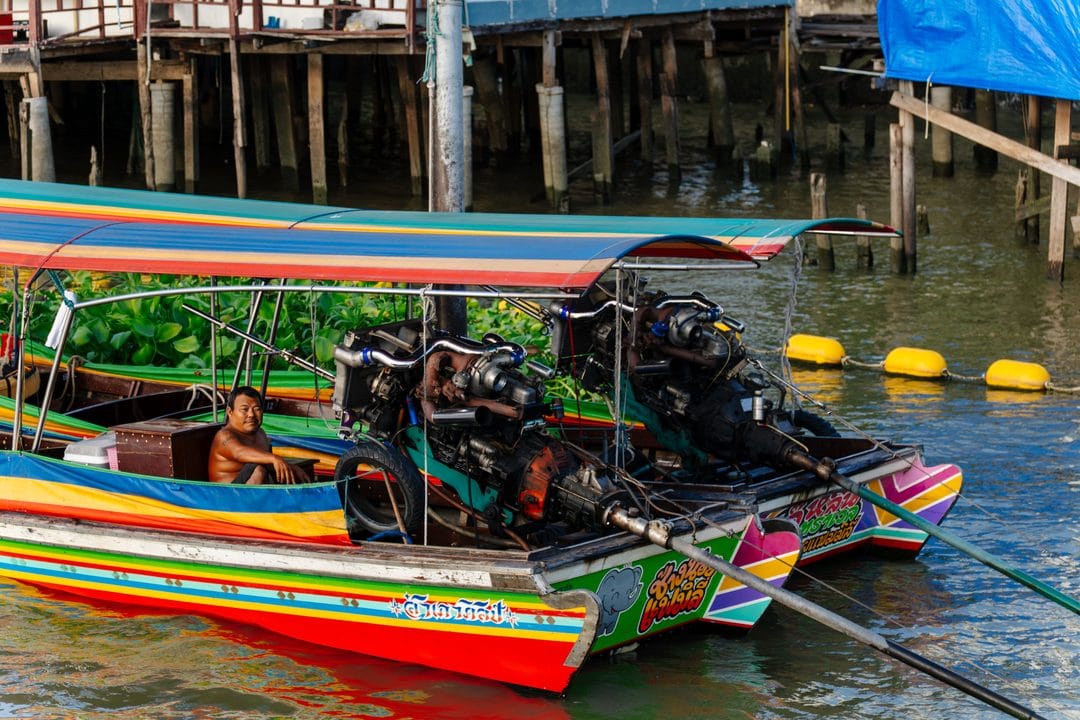
At 8:15 on a Tuesday morning, the traffic on Sukhumvit Road barely moves — brake lights stacked for three blocks past Asok, a river of tuk-tuks and taxis going nowhere. One flight of stairs down from the BTS Skytrain, though, a low wooden boat with a rattling diesel engine pulls away from Asoke Pier and cuts east along Khlong Saen Saep at a speed no motorbike taxi could match in this traffic. Twelve minutes later it's at Thong Lo. The BTS covers the same stretch in about the same time when it's running smoothly, but the boat costs less, and on the mornings when a Skytrain signal fault backs up three stations, it's the only thing in the neighbourhood still moving on schedule.
Bangkok built its canal network — the khlongs — centuries before anyone laid a Skytrain rail, and for a long stretch of the twentieth century the city more or less turned its back on them, paving some over for roads and letting others become drainage afterthoughts choked with plastic and runoff. What's changed in the last few years isn't the canals themselves so much as who's willing to admit they still work. Office workers who'd never have considered a khlong boat a decade ago now treat the Saen Saep line the way Londoners treat the Overground: not glamorous, but faster than the alternative when it counts.
The Saen Saep line: Pratunam to Bang Kapi, one splash at a time
The workhorse route is the Khlong Saen Saep boat service, running roughly 18 kilometres from Pratunam Pier near the Platinum Fashion Mall out to Wat Sriboonruang in Bang Kapi, with a transfer point partway at Wat Sriboonruang for the further eastern extension toward Nida and Bang Kapi's markets. Fares are staged by distance — expect somewhere between 10 and 20 baht for a single ride, paid in cash or by tapping a rechargeable boat card at the pier gate, and nobody's pretending the boats are new. Most of the fleet is decades-old fibreglass-and-wood hulls with a single diesel outboard, no air conditioning, and bench seating that fits about 40 people if everyone squeezes.
Asoke Pier is the interchange that makes the line legible to anyone who already knows the Skytrain map: it sits directly beneath BTS Asok and a short walk from MRT Sukhumvit, so a commuter can ride the subway in from Lat Phrao, cross under the expressway, and drop onto a canal boat heading toward Phra Khanong or Thong Lo without ever surfacing into traffic. Further west, Pratunam Pier does the same job for anyone working around Ratchaprasong or Chidlom — it's an easy 10-minute walk to Central World, and on a day when the Skytrain is packed to the doors after a big event at CentralWorld, the boat queue at Pratunam moves faster than the taxi rank outside.
Phan Fa Lilat and the Golden Mount detour
Ride the line all the way to its western terminus and you land at Phan Fa Lilat Pier, a short walk from Wat Saket and the Golden Mount — the gilded chedi on an artificial hill that's one of the older vantage points over the old city, well before anyone built an observation deck at a shopping mall. It's not a stop most guidebooks flag as a canal-boat destination, and that's exactly the appeal: tourists cluster at the river piers along the Chao Phraya, while the Golden Mount gets visitors who came by khlong boat because it happened to be the fastest way there from Pratunam, not because a tour operator sold them the route.
This is where the two systems genuinely diverge. The Chao Phraya has been dressed up for visitors — clean piers, English signage, tourist boats with hourly departures. Khlong Saen Saep has had none of that treatment, and it shows in a good way: the fares stayed low because nobody bothered redesigning the service around a foreign customer base, and the boats still run on the same rough schedule locals have used for years, arriving every few minutes at peak times without a printed timetable in sight.
The splash curtains are not a joke
Anyone who's ridden Saen Saep more than once knows the drill: as the boat approaches a low bridge, the crew hauls a heavy blue tarp up the length of the open sides, and everyone ducks. It's there to block the spray the boat's own wake throws up against the concrete pilings, and khlong water is not something you want on your shirt — the canal has carried decades of runoff, and while the city has invested in pumping stations and periodic dredging, water quality along the Saen Saep corridor remains visibly poor in stretches near Din Daeng and Bang Kapi. Splash-related skin irritation is common enough that regular riders keep a spare shirt at the office; it's a minor cost of a route that otherwise beats sitting in traffic, but it's real, and it's the one thing every first-time rider gets warned about by whoever talked them into trying the boat.
The river route: flags, fares, and where MINE fits in
Running parallel and a few kilometres west, the Chao Phraya Express Boat serves an entirely different geography — the river itself, from Nonthaburi in the north down past the Grand Palace, Wat Arun, and ICONSIAM to Sathorn in the south. The flag system takes some learning: orange-flag boats run end to end for a flat fare, typically in the 16-to-20-baht range regardless of how far you travel, while boats flying no flag, a yellow flag, or a green flag serve shorter or express segments with their own fare tiers. Tourist Boats with a blue flag charge considerably more — often 40 to 60 baht per hop — in exchange for narrated stops and English announcements at the major sightseeing piers.
The most visible recent change on the river is the MINE Smart Ferry, an electric catamaran fleet introduced in 2020 that now runs a fixed loop through central piers including Sathorn (Taksin), ICONSIAM, and stops near Wat Arun. It's quieter than the diesel boats — no engine rattle, no exhaust smell drifting over the pier — and the fare sits around a flat rate regardless of distance within its loop, aimed squarely at commuters and shoppers heading to ICONSIAM rather than at long-haul river traffic. Whether electric propulsion makes financial sense across the whole Chao Phraya fleet is still an open question; diesel boats are cheaper to maintain and easier to repair at short notice, and the electric fleet so far covers only a fraction of the piers the older boats serve.
What the city says is coming next
Bangkok's canal transit ambitions go well beyond the Saen Saep and Chao Phraya lines already running. City planners at the Bangkok Metropolitan Administration have floated adding an electric boat service on Khlong Prem Prachakon, the long north-south canal that runs past Chatuchak and up toward Sai Mai, as a way of relieving pressure on roads in a part of the city the Skytrain and MRT haven't fully reached yet. Progress on canal-based transit in Bangkok has a habit of moving slower than announced — the Saen Saep line itself took decades to go from informal ferry service to something the city actively promotes — so treat any specific opening date with some scepticism until boats are actually running.
What's not in doubt is the demand. Ridership on Saen Saep climbs every time a major road nearby gets dug up for construction, and pier staff at Asoke will tell you the morning rush now starts earlier than it did five years ago, as more commuters build the boat into their regular route rather than treating it as a backup plan. A city that spent most of a century treating its canals as an embarrassment is quietly turning them into one of its more reliable pieces of infrastructure — not because anyone solved the water-quality problem, but because gridlock made the trade-off worth it.
If you're visiting and want to try it without the learning curve, ride Saen Saep from Pratunam to Asok around midday, well outside the 7:30–9:00 rush — the boats run less crowded, the splash curtains still go up at every bridge, and you'll get from the shopping district to Sukhumvit faster than any taxi stuck behind a delivery truck on Ratchadamri Road.