The River as Living Room: How Seoul's Han River Parks Became the City's Default Evening Out
From 1 September to 30 November 2026, Seoul lets picnic tents stay up on the Han River until 10 p.m. instead of 7. How eleven riverside parks became the city's default evening out, what the rules are, and what is on this October.
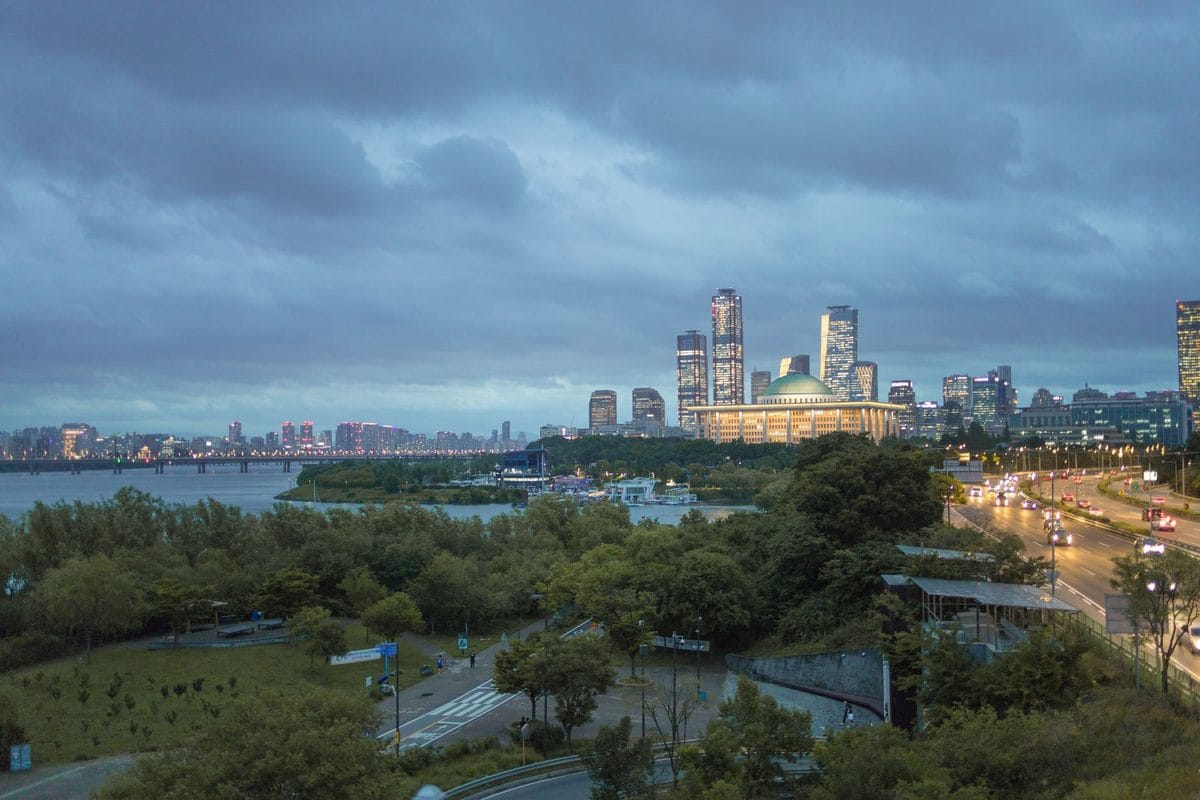
Between 1 September and 30 November this year, a four-person shade tent on the bank of the Han River can stay up until 10 p.m. The standing rule for spring and autumn is that tents come down at 7 p.m., and the Seoul Metropolitan Government has relaxed it for the season so that people can stay on the river from daytime into the night. Three extra hours of tent time sounds like paperwork, but it tells you how the city now thinks about its eleven riverside parks: as the place where an evening is supposed to happen, not just a strip to cycle along on a Sunday morning.
What that evening looks like is easy to describe and hard to find anywhere else. A convenience store inside the park has a self-service cooker that fills a pot with water and boils a pack of instant noodles in a few minutes. A delivery zone at the edge of the grass is where the fried chicken arrives, because the rider is not allowed to bring it to your blanket, and the skyline does the rest. It costs a few thousand won, it needs no booking, and in early October, with the heat gone and the sun setting around six, it is at its best.
A flood-control strip that people kept using
The Hangang parks have a plain origin. According to the Seoul Metropolitan Government, the story begins in 1982 with the transformation of the riverbanks under the Hangang development project, when what had served mainly as flood-control infrastructure was reimagined as green public space. In 1992 the area officially received the name Hangang Park, made up of 11 parks. The city dates the rapid growth in visits to the completion of its Specialization Project of Hangang Parks in 2009, which fitted the main parks with features such as a rose garden, a cascade plaza and musical fountains.
The numbers moved fast after that. A city survey of 2013 visits, published in English by the Seoul Metropolitan Government, counted 68.62 million visits to the parks that year, an average of 6.6 per Seoul resident and 1.8 times the 2009 total of 38.83 million. Yeouido alone took around 29.5 million of them. April was the peak month, with 14.44 million visits, or 21 per cent of the year, but October came second at 8.37 million, ahead of August and June. Between them, April and October took a third of the year's visits.
Eleven parks, two kinds of crowd
Treat the eleven parks as one thing and you will pick the wrong one. The city's Future Hangang Headquarters publishes monthly visit counts based on telecom data, and the guide site Seoul Window tabulated the May 2026 figures: 9.86 million visits in the month across all eleven parks, with Yeouido first at about 1.66 million. Only 19.5 per cent of Yeouido's visitors were classed as locals, though, against 51.6 per cent at Gwangnaru, 47 per cent at Ttukseom and 17.1 per cent at Nanji. Seoul Window reads the split as neighbourhood parks, where residents walk over after dinner, versus destination parks, where you need a reason to show up, whether that is a campsite, a festival or a bird observatory. Yeouido is the second kind, and its foreign visitors still made up only about 1.3 per cent of its May visits.
The peak hours back that up. Nanji and Gangseo are busiest around 4 p.m., Yeouido, Ichon and Yanghwa at 6 p.m. as the offices empty, five more at 7 p.m., and Jamsil at 8 p.m., the latest of the eleven, which fits a park used for night running and cycling. Festivals change the picture: the 2026 Seoul Spring Festival ran from 10 April to 5 May across Yeouido, Ttukseom, Jamsil and other parks, and drew 7.06 million visitors, of whom 1.17 million, about 17 per cent, were foreign. For a first autumn visit, go to Ttukseom or Gwangnaru if you want to see how Seoulites actually use the river, and to Yeouido only if you want the shops, restrooms and delivery zones all in one place.
Noodles, chicken and where you are allowed to sit
Hangang ramyeon, the noodles cooked in the park's convenience-store machines, has turned into a seasonal retail event. BGF Retail, the company behind CU, reported in April 2025 that instant-ramyeon sales at about ten of its stores near the Han River rose 286 per cent year on year between 11 and 20 April, once daytime highs passed 20 degrees. On 20 April alone the average store sold about 1,000 packs. Recent visitor guides put a finished bowl at roughly 4,000 to 4,800 won. Take the cooker over delivery on a first visit: it is cheaper, nothing needs coordinating, and you end up eating what the people on the next patch of grass are eating.
The rules for everything else are more specific than the casual atmosphere suggests.
- Mats are allowed in the parks at any time of year, with no zone restriction.
- Tents of roughly 2 m by 2 m, big enough for four, are allowed only inside one of 15 designated zones, between 1 March and 30 November.
- Delivery motorcycles are kept out of the park for safety, so food ordered by app is collected at a delivery zone and carried to wherever you are sitting, a step first-timers tend to forget.
- Camping and cooking outside designated places are banned under Article 17 of the city's Hangang Park ordinance, with a first-offence fine of 1 million won, which rules out the portable stove, the little grill and the like.
- Leaving your own rubbish behind is a separate offence, fined at 100,000 won.
The city's notice lists Yeouido and Ttukseom as the parks with delivery zones, and Seoul said in July that it would raise the number of designated delivery zones from six to eight. Bring a mat, not a tent. A mat works in any park on any evening, including after the tent deadline, while a tent ties you to a zone and a timetable.
The bars thinned out and the river filled the gap
Seoul has fewer pubs and bars than it did two years ago, and the city is open about it.
The Korea Herald reported in July that the number of pubs and bars in the city had fallen 14.5 per cent over two years, according to the Seoul Metropolitan Government. It also reported that average ridership after midnight at Gangnam Station dropped to 599 last year from 1,109 in 2019, according to Seoul Metro. That is the backdrop to the first project under the city's new night economy strategy, unveiled in late July. As announced, it provided free temporary campsites for up to 200 tents at Yeouido and Ttukseom in August, with camping equipment to rent on site. The swimming pools extended their hours to 10 p.m. from early July, poolside DJ parties were scheduled from 7 to 9 p.m. on Fridays, Saturdays and Sundays, and the evening programme added guided walks, open-air film screenings and dance events, plus multilingual ordering guides for international visitors.
None of this proves that closing bars sent people to the grass; the figures describe two trends side by side, not a cause. Chung Yeon-seung, a business professor at Dankook University, told the Korea Herald that the Han River compares favourably with waterfronts in other major capitals, but also that the parks may have weaker direct links to the surrounding business districts than downtown attractions do. His point was that people who settle on a lawn and order in do not necessarily walk into the restaurant on the corner. A crowd on the grass is not automatically a crowd in the shops.
What is on the water this October
The Seoul Metropolitan Government has lined up a busy month. The Seoul Light Hangang Bitseom Festival on Nodeul Island, now in its fourth year, runs through 11 October and had drawn about 299,000 visitors from its opening to Monday 5 October, the city said. Public transport use around the island rose sharply too: Seoul counted 125,000 passengers at Nodeul Station and nearby bus stops from Friday to Monday, against about 47,000 over the same days in September, and shuttle buses ran between Sinyongsan, Nodeul and Noryangjin stations from 5 to 11 p.m.
| When | Where | What |
|---|---|---|
| Through 11 October | Nodeul Island | Seoul Light Hangang Bitseom Festival, laser and media-art installations |
| From Friday 9 October | Hangang PlayPlace, Ttukseom | Hangeul Day programme from 1 p.m., then a drone light show, Joseon Fantasy, at the Ttukseom waterfront stage |
| 10 and 17 October, 2 to 4:40 p.m. | Gwangjin Bridge 8th Avenue | Free live performances in the observation deck under the bridge |
| 18 and 25 October, 7 to 9 a.m. | Gwangjin Bridge 8th Avenue | Morning walks across the bridge |
Banpo has its own October attraction. The Moonlight Rainbow Fountain on Banpo Bridge, registered with Guinness World Records on 7 November 2008 as the world's longest bridge fountain, stretches 1,140 metres along the bridge. In October the 20-minute shows run at noon and then at 7:30, 8, 8:30 and 9 p.m., according to the city's official page, which also lists the conditions that switch the fountain off: wind of 7 metres per second or more, rain forecast for show times, and high river turbidity. Check the schedule on the day, and do not build a whole evening around a show that may not run. A convenience-store dinner on the grass near the bridge is a plan that still works if the fountain does not.
The tent allowance lapses with the season on 30 November, a Monday. After that it is mats only, and the river goes back to being something you cross in a coat on the way somewhere else.