Under the Five-Foot Way: How a 200-Year-Old Building Rule Still Runs Monsoon-Season Asia
A building rule from 1822 still shelters more of monsoon-season Asia than any glass skywalk built since — and the reasons why say a lot about who cities are actually designed for.
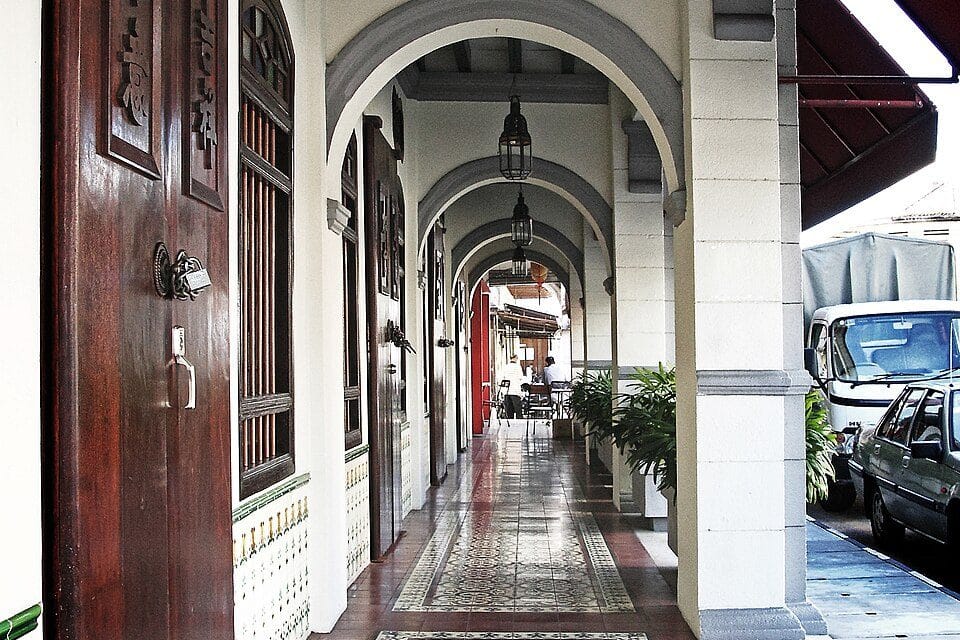
On Kimberley Street in George Town, the rain doesn't announce itself so much as arrive mid-sentence. One moment a hawker is calling out prices for char kway teow, the next the sky opens and the whole street disappears behind a curtain of water — except for the five-foot strip under the shophouse eaves, where nothing changes at all. The tailor two doors down keeps sewing. The kopitiam owner keeps stacking glasses. A courier on a Yamaha pulls in under the overhang, checks his phone, and waits it out without ever getting off the bike.
Nobody built that shelter for him. It was mandated into existence more than two centuries ago, for reasons that had nothing to do with food delivery, and it still outperforms almost everything Asian cities have built since to solve the same problem.
A Building Rule From 1822 That Never Left
When Stamford Raffles drew up his 1822 town plan for Singapore, he wrote in a requirement that every shophouse set back a continuous covered passage — roughly five feet, hence the name — along its street-facing frontage. The stated reasons were fire safety and shade, not rain, but the effect was the same either way: a covered, uninterrupted arcade running the length of the block, open to anyone on foot. The rule migrated with British administration across the Straits Settlements and got written into municipal ordinances in Penang and Malacca, which is why the same feature shows up today in shophouse rows from Chinatown in Singapore to Jonker Street in Malacca to Kimberley Street in George Town. Locals call it kaki lima — "five feet" in Malay — and the name stuck even where the exact width didn't.
What makes the five-foot way different from a normal awning is continuity. A single shopkeeper closing early or extending a counter into the passage doesn't just inconvenience their own customers — it breaks the line for everyone walking the block behind them, which is exactly the kind of externality a 19th-century colonial ordinance was blunt enough to legislate against and modern zoning codes, oddly, mostly aren't.
What the Overhang Actually Carries
Walk any working five-foot way in July and you'll find it doing far more than sheltering pedestrians from a downpour. It's commercial real estate that nobody pays rent for, and small operators have organised their whole business around that fact:
- A shoe-repair stall that fits into roughly two square metres and moves its stool a few feet with the sun
- Key-cutters and locksmiths, who tend to hold the same corner for years because customers learn to find them there rather than by any signage
- Grab and foodpanda riders treat the overhang as a waiting room between orders, phones propped against a pillar
- Elderly residents sitting out once the day's heat breaks, fruit carts angling under whichever stretch stays driest, unlicensed hawkers who don't appear on any council list — and so on, block after block
None of this is planned or scheduled. It just accumulates, block by block, because the covered space is free, public, and predictable in a way that almost nothing else in a dense Asian city centre is. The gig economy didn't invent that dependency, but it has made it far more visible: a Grab driver waiting out a squall under a shophouse eave is running the exact same calculation a rickshaw puller made a century ago, just with a different app open. Take the five-foot way away and you don't just lose a walking route — you lose the one place in the block where a dozen unrelated livelihoods can all wait out the same fifteen minutes of rain for free. You'll see the same rhythm play out at a wet-market five-foot way in Chinatown or a shuttered arcade in Little India: carts angle in, awnings tilt, and within a minute the block has rearranged itself around the weather without a single sign or app telling anyone how.
Singapore took the same logic and wrote it into public housing policy more than a century later. Housing & Development Board estates are laced with covered linkways connecting almost every block to its nearest bus stop, MRT entrance, or wet market, and residents in newer estates routinely petition for extensions after a wet season spent without one. It's the same five-foot-way principle — a continuous, mandated line of shelter — applied at the scale of an entire town rather than a single street, and it may be the most direct descendant Raffles's 1822 ordinance has anywhere in the region.
Every City Solved the Same Problem a Different Way
Hong Kong just built its way over the hill instead of under it.
That system — the Central–Mid-Levels escalator, opened in 1993 — runs roughly 800 metres up the slope from Queen's Way to Conduit Road, and on a wet afternoon it does exactly what a five-foot way does at street level: it keeps thousands of commuters dry and moving without anyone stepping onto a road. Under Japanese colonial-era building codes from the early 1900s, Taipei took a third approach entirely — shophouses were required to build a covered arcade called tiānzǐjiǎo, still visible today in older districts like Dihua Street, functionally identical to Penang's five-foot way but arrived at independently. And Bangkok went vertical rather than horizontal, threading an elevated Skywalk between BTS stations along Sukhumvit and Silom so commuters can move between Siam, Chit Lom and Phloen Chit without ever touching street level, whether the sky is doing anything or not.
The Air-Conditioned Version Isn't the Same Public Space
It's tempting to treat Bangkok's Skywalk or Kuala Lumpur's Pavilion–KLCC bridge as the modern, upgraded version of what George Town's shopkeepers built by accident. They're not, and the difference matters more during monsoon season than at any other time of year.
A five-foot way is street-level public right-of-way — you can step into it and out of it at any point along the block, at three in the morning, without walking through a single door someone else controls. A mall skywalk is a private corridor with public access hours: it closes when the mall closes, it's patrolled by private security rather than municipal enforcement, and getting from one end to the other usually means passing through at least one retail floor that expects you to look like a customer. The catch is that the five-foot way's real advantage — that nobody owns it — is also its biggest weakness: nobody is responsible for keeping it clear, either, which is exactly the problem eating into it today.
Why This Gets Harder to Protect, Not Easier
George Town's five-foot ways have carried UNESCO World Heritage status since 2008, alongside Malacca, and George Town World Heritage Incorporated actively fines shophouse owners who block their stretch with parked motorcycles, rolled-down shutters, or bolted-on air-conditioning compressors. Even with that enforcement layer, whole sections of Chulia Street and Campbell Street still force pedestrians out onto the road during a downpour because a shop owner treated their five feet as private storage. Kuala Lumpur's older quarters, which never got heritage protection at that level, have it worse — walk Petaling Street or the backstreets of Bukit Bintang after a storm and you'll find entire blocks where the covered passage exists on paper and nowhere else.
Skip the newer shophouse conversions advertised as "heritage-style" that have glassed in their own five-foot way to add floor space to a café or boutique — they photograph well and they're useless the day it actually rains, because the one continuous dry line through the block now has a gap exactly where the café owner decided their seating mattered more than the street's. If you're flat-hunting in George Town or Kuala Lumpur's older districts ahead of the wetter months, walk the block before you sign anything: a five-foot way choked with scooters and shutters is a real signal about how the building — and its neighbours — are managed, not a cosmetic detail, and landlords almost never bring it up first.
None of Asia's newer, glossier answers to bad weather — the skywalks, the mall bridges, the underground concourses — actually replace what a colonial-era building ordinance produced almost by accident: a public, unowned, unbroken line of shelter that opens exactly where the street does. The rain hasn't gotten any lighter this July. The five-foot way is still the only piece of infrastructure in most of these cities that was built assuming it wouldn't.