The Trail Before the Timesheet: How Pre-Dawn Hiking Became East Asia's Real Office Hours
Before the workday even starts, office towers across Seoul, Tokyo, and Taipei empty onto mountain trails — a ritual that's less about fitness than about claiming the one hour nobody else has taken yet.
The 5:12 A.M. Meeting Nobody Put on a Calendar
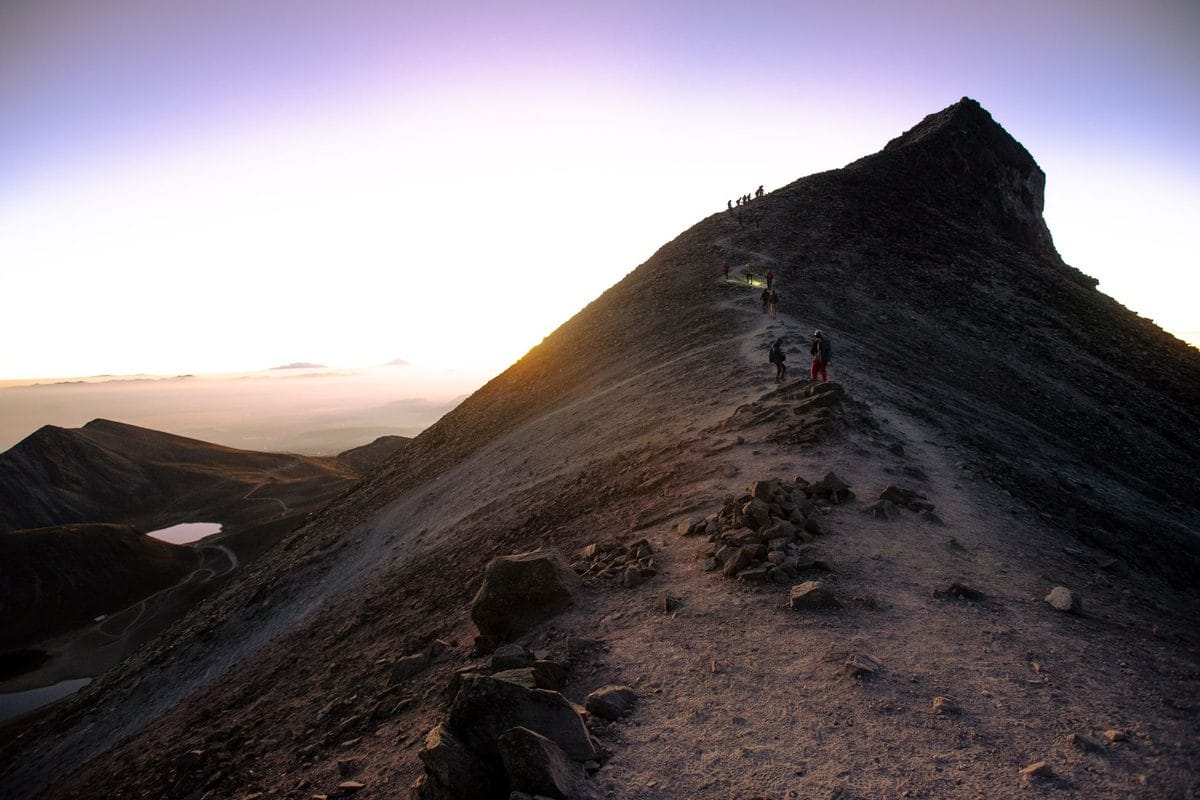
At 5:12 a.m. on a Saturday in northern Seoul, the parking lot below Bukhansan National Park is already full, headlamps bobbing up the granite switchbacks of Baegundae before the sky has decided whether it wants to be blue or gray. Most of the fifteen people climbing together work the same floor of the same office tower in Gangnam, and by nine they will be back at their desks, showered and in blazers, answering emails as though nothing unusual happened before sunrise. Retailing for roughly $150 to $220, Blackyak daypacks show up so often on this trail that the domestic outdoor brand has become something close to an unofficial uniform. Nobody organized any of it through a corporate wellness program. Instead, the meeting time came out of a Band app group chat, the messaging tool Korean hiking clubs have used for more than a decade to schedule Saturday climbs around shift patterns, school runs, and the occasional hangover. And that is the part visitors rarely notice: an activity that looks, from the trailhead, like pure leisure has quietly become one of the more reliable places in the city to be seen by your team lead.
Baegundae tops out at 836 meters, modest by regional standards, but the approach is steep enough that most groups budget two and a half hours up and ninety minutes down — tight enough, if you start at 5 a.m., to be showered and at your desk by 10. That timing is not an accident. It is the entire point.
Why the Trail Opens Before the Office Does
South Korea's 52-hour workweek cap, phased in from July 2018 and extended to smaller companies through 2021, was supposed to hand workers their evenings back. In practice, many white-collar employees report that meetings, client calls, and informal obligations simply migrated to compress what free time remained, leaving early mornings as the one block of the day nobody else has claimed yet. Tokyo went through a parallel shift after the 2019 work-style reform law capped overtime and pushed companies to track hours more strictly — and the response, especially among employees in their thirties and forties, was to reclaim the pre-commute window rather than the post-work one. Ask someone on the Takao-bound platform at Shinjuku Station at 6:40 a.m. why they're heading to the mountains instead of sleeping in, and the answer is rarely about fitness targets. It's usually some version of: this is the only hour that's actually mine.
Here's the part that doesn't fit neatly into a wellness narrative: in some Korean companies, skipping the Saturday climb with your department head is read as a small but real signal, the kind that shows up later in who gets pulled into the good projects. The hike is framed as optional. Attendance quietly isn't.
The Gear Economy Bankrolling the Ritual
None of this would scale the way it has without a retail ecosystem built specifically around it. Kolon Sport, K2, and Blackyak dominate Korean outdoor apparel with stores in nearly every neighborhood that borders a trailhead, and their sales calendars are built around spring and autumn hiking seasons rather than the ski-and-swim cycle Western outdoor brands chase. A mid-range Gore-Tex shell from any of the three runs $200 to $350; a full first-season kit — boots, poles, a daypack, a headlamp, and so on — lands most new hikers somewhere around $400. Don't buy imported alpine gear for your first season. A pair of Korean-made trail runners from a local outdoor shop or a Decathlon outlet handles Bukhansan's granite just fine, and the money you save is better spent on a decent headlamp — cheap ones die on the descent, which is the one stretch of the hike where you actually need the light.
Montbell, the Japanese equivalent, plays the same role around Tokyo, and its Shinjuku flagship opens at 10 a.m. — deliberately timed for hikers coming down off Takao who want to browse before the trains fill up. The wellness economy tied to all this isn't an abstraction measured in vague growth percentages; it's a specific set of storefronts, membership clubs, and Saturday-morning queues at gear counters that wouldn't exist if the hiking habit were actually just about hiking.
Tokyo and Taipei Run a Shorter, Steeper Version
Mount Takao, at 599 meters, earned three stars in the Michelin Green Guide Japan back in 2007 — the same rating system used for restaurants — and the accolade turned what had been a regional day trip into something closer to a pilgrimage circuit, complete with a funicular railway for anyone who wants the view without the climb. Commuter hikers mostly skip the cable car. They want the sixty minutes of exertion before the trains fill up, not the scenery on its own.
Taipei compresses the whole idea into something closer to a stairmaster with a skyline attached. Elephant Mountain, or Xiangshan, rises only 183 meters from the MRT station of the same name, and the roughly 600 stone steps to the main viewing platform take most office workers twenty-five to thirty minutes at a brisk pace. It has none of Bukhansan's scale or Takao's cachet, and that's precisely why it works for a 6 a.m. crowd who need to be showered and at a desk in Xinyi by eight. Recommend Xiangshan without hesitation to anyone new to this habit and short on time before work — it rewards the effort in under half an hour in a way Bukhansan simply cannot.
Hong Kong Skips the Corporate Hierarchy Part
Dragon's Back, the ridge trail above Shek O that CNN once named one of Asia's best urban hikes, draws a similarly early crowd out of Shau Kei Wan on weekend mornings, but the social mechanics work differently here. Hong Kong's finance and legal sectors run long, unpredictable hours that make a fixed 5 a.m. team hike impractical to enforce even informally, so most groups form through expat hiking meetups and WhatsApp chats rather than anything resembling a department chain of command. The trail itself runs about 8.5 kilometers along Hong Kong Trail Section 8, finishing at Big Wave Bay in time for a swim and a coffee before a 10 a.m. call. It's the same instinct driving Seoul's ritual — claim the daylight before someone else claims your calendar — minus the unspoken attendance sheet.
The Summit Has a Cost Nobody Puts on the Group Chat
Overcrowding is the trade-off nobody advertises.
Bukhansan draws close to five million visitors a year according to Korea National Park Service figures, concentrated overwhelmingly on weekend mornings, which means the granite switchbacks that felt meditative at 5:15 turn into a queue by 7. Trail erosion around the main routes has forced the park service to rope off and rotate sections in recent years, and rescue callouts — mostly slips on wet granite in the dark — spike every spring and autumn. None of that has slowed the growth of the ritual. If anything, the crowding has become its own kind of proof that the habit is real, not a fad someone will quietly abandon once the next corporate trend arrives.
What holds the whole pattern together, across three cities with three different languages and three different trailheads, is a shared refusal to accept that the workday has to start at the office door. The mountain got there first this morning. The office can wait the ninety minutes it takes to walk back down.