Two Wheels, One City: How Asia's Bike-Share Networks Turned the Commute Into a Habit
YouBike, Ttareungyi and Anywheel didn't just add bikes to the street — they rewired how three Asian cities commute, one fifteen-minute ride at a time.
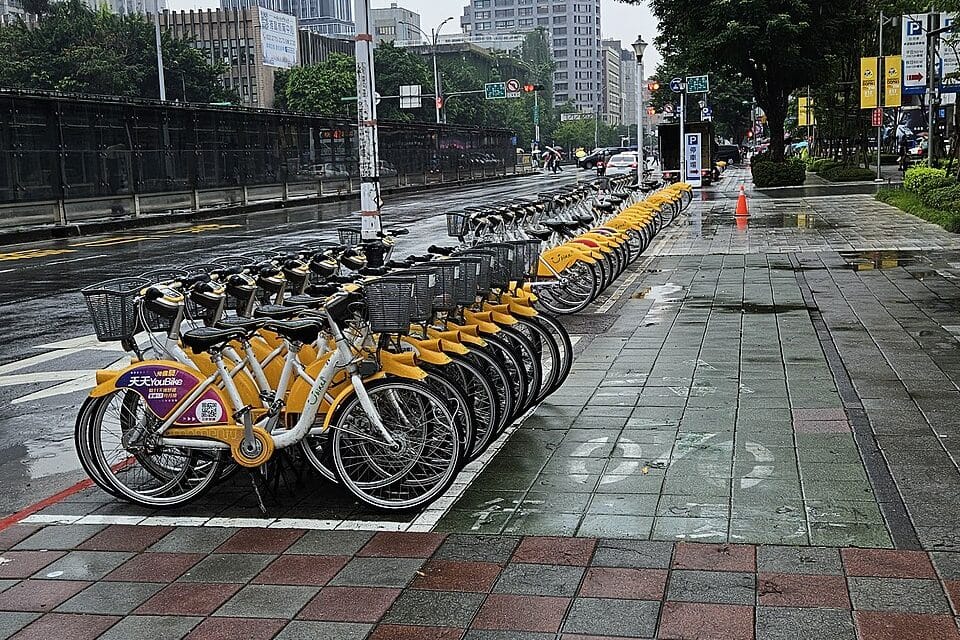
Seven in the morning at the YouBike dock outside Taipei's Da'an Park, and the last two bicycles are gone within ninety seconds of each other. A woman in office clothes taps her EasyCard against the reader, pulls a bike free, adjusts the saddle without breaking stride, and merges into a bike lane already carrying a dozen other commuters doing the exact same thing. Nobody is wearing lycra. Nobody is training for anything. This is just how you get from the MRT exit to the office when the office is eight minutes away by bike and twenty-five by foot.
That scene repeats itself, with local variations, across a dozen cities from Kaohsiung to Busan to Jurong East. Bike-share in Asia has quietly stopped being a novelty transport pilot and become something closer to plumbing — unglamorous, expected, and load-bearing for how millions of people actually move through their day. You notice it the way you notice good drainage: mostly by its absence when a system breaks down.
Taipei's YouBike solved the boring part first
YouBike, run by Giant in partnership with Taipei City, launched back in 2009 with 500 bikes and nearly failed within its first year — usage was too low, stations too sparse, and the whole thing looked like it might get quietly shelved. The turnaround came from a decision that sounds almost too simple to matter: the city stopped trying to make bike-share a destination activity and started treating it as a transit connector, wiring stations directly into MRT exits, bus stops, and university gates. By 2016 there were over 400 stations packed into central Taipei; today the network spans well past 1,600 stations island-wide with more than 30,000 bikes in circulation.
The pricing tells you who this is built for. The first thirty minutes cost NT$5 (about US$0.16), rising in NT$5 increments per half hour after that — cheap enough that a fifteen-minute hop from home to the nearest MRT station barely registers as an expense, but structured to push riders off the bikes and back onto public transit for longer trips rather than encouraging all-day rentals. That's a deliberate policy choice, not an accident of the fee table, and it's the reason YouBike reads as commuter infrastructure rather than tourist novelty. Ride past any dock at 8am on a weekday and you'll see the proof: near-empty racks, all the bikes already out working.
Seoul's Ttareungyi and the last-mile habit nobody planned for
Seoul came at the same problem from a different angle. Ttareungyi — the name literally riffs on the sound of a bicycle bell — launched in 2015 with 2,000 bikes and has since grown into a fleet exceeding 40,000 across the city, run by the Seoul Metropolitan Government rather than a private operator. Where Taipei leaned on MRT integration, Seoul's system leans hard into apartment-block density: docking stations cluster around residential complexes, not just subway exits, because the real gap in Seoul's transit map was never the big trunk lines — it was the ten-to-fifteen-minute walk between a subway stop and the actual front door of a Gangnam-gu high-rise.
A monthly pass runs around ₩5,000 (roughly US$3.70) for unlimited one-hour rides, which is cheap enough that Seoul commuters treat it less like a transport decision and more like a standing default — you don't think about whether to take a Ttareungyi, you think about whether there's a reason not to. And there's a mobile app quirk locals rely on constantly: it shows real-time bike counts per station, so regular users develop a mental map of which docks reliably have stock at 8am versus which ones are always empty by 7:45. That kind of granular, habitual knowledge is exactly what separates a transit system people merely tolerate from one they've built their daily rhythm around.
Singapore took the opposite bet — and it mostly paid off
Singapore's approach diverges sharply from both. Rather than running one government-backed dockless or docked system, the city-state let private operators compete: Anywheel currently dominates with a GPS-geofenced dockless model, after SG Bike and oBike both collapsed earlier in the decade under complaints about bikes dumped in drains, blocking void-deck walkways, and cluttering HDB estates. Anywheel's fix was blunt but effective — riders must park within a marked geofenced zone or the app locks them out of ending the ride, with a small penalty fee for violations. It's not elegant, but it solved the exact failure mode that killed the earlier operators.
Pricing sits around S$1 (about US$0.74) for the first hour on a standard plan, and Singapore's near-total network of Park Connectors means a ride can genuinely replace a short MRT hop rather than just supplementing it, particularly across the East Coast and Bedok corridors where the cycling paths run separated from traffic for long, uninterrupted stretches. This is worth saying plainly: if you're weighing bike-share against a Grab ride for anything under three kilometres in Singapore, take the bike — it's faster door-to-door once you account for waiting for a car, and it costs a fraction of the fare.
Why this counts as lifestyle, not just transit
None of this shows up in a ridership graph.
What ties Taipei, Seoul, and Singapore together isn't the technology — dockless GPS locks and docked kiosk systems are just different flavours of the same idea. It's that each city built bike-share into the texture of an ordinary day rather than positioning it as an event. Riders aren't suiting up for a ride; they're wearing whatever they wore to the office, carrying whatever bag they were already carrying, taking a bike the way they'd take an escalator. That shift — from "cycling as recreation" to "cycling as one more mode on the commute menu" — is the actual innovation, and it's worth more attention than the hardware ever gets.
It shows up in secondary ways too. Cafés near major docking clusters in Seoul's Yeonnam-dong now design their outdoor seating with bike parking in mind, not as an afterthought bolted onto a fence. Taipei's night market vendors near YouBike-dense intersections report a visible uptick in customers arriving by bike rather than scooter, which changes what gets sold — smaller, more portable snacks win out over things meant to be eaten sitting down. None of this was planned by the transit agencies. It's just what happens when enough people build a two-wheeled habit into thousands of small daily decisions.
The friction nobody advertises
None of these systems are frictionless, and it's worth being honest about where they strain. Helmet compliance is essentially unenforced across all three cities — Singapore technically requires helmets on Park Connector cycling paths but almost nobody carries one for a fifteen-minute bike-share hop, and enforcement is close to nonexistent in practice. Monsoon season turns Taipei and Singapore docks into ghost towns for days at a stretch, and none of the three networks have solved covered parking at any real scale; you either ride in the rain or you don't ride. And bike theft, while lower than you'd expect thanks to GPS tracking and the geofencing penalties, still spikes around university exam periods in Seoul, when students dump borrowed bikes far from any dock to save a few minutes and eat the fine.
The systems that work best also share something less visible: they're subsidised, directly or indirectly, by city government, because the fare alone never covers redistribution costs — the trucks that ferry surplus bikes from full downtown docks back out to residential areas where the racks run empty by 9am. Seoul owns and runs Ttareungyi outright for exactly this reason. Taipei splits the cost with Giant. Singapore is the outlier, betting that private operators can make the unit economics work on ride fees plus advertising — a bet that's held for Anywheel so far, but one that already broke twice before it did.
What a visitor should actually do with this
If you're spending more than three days in any of these cities, get the app and the local transit card before you touch a taxi. Grab's convenient, but for anything under two kilometres in flat, well-connected districts — central Taipei, Seoul's river-adjacent neighbourhoods, Singapore's East Coast — a shared bike beats it on time, cost, and honestly on the view. Skip it only if you're staying somewhere genuinely hilly, like parts of Busan, where the bike-share bikes are heavy, single-speed, and simply not built for the gradient.
The bigger takeaway for anyone watching Asian cities from outside is that none of this required a moonshot. Taipei, Seoul, and Singapore didn't invent bike-share — European cities had docked systems years earlier. What they did was integrate it so tightly into transit maps, pricing structures, and daily habits that riders stopped treating it as a separate decision. That's the part worth copying, and it's also the part that's hardest to see from a press release: not the bike, not the app, just the fifteen minutes a million small decisions saved, repeated every single morning.