The Escalator That Became a Street: How Hong Kong, Chongqing and Yokohama Move People Up a Hillside
Hong Kong's Central-Mid-Levels Escalator carries roughly 85,000 people a day up a slope no bus could climb. It is not a novelty. It is a street that happens to be tilted.
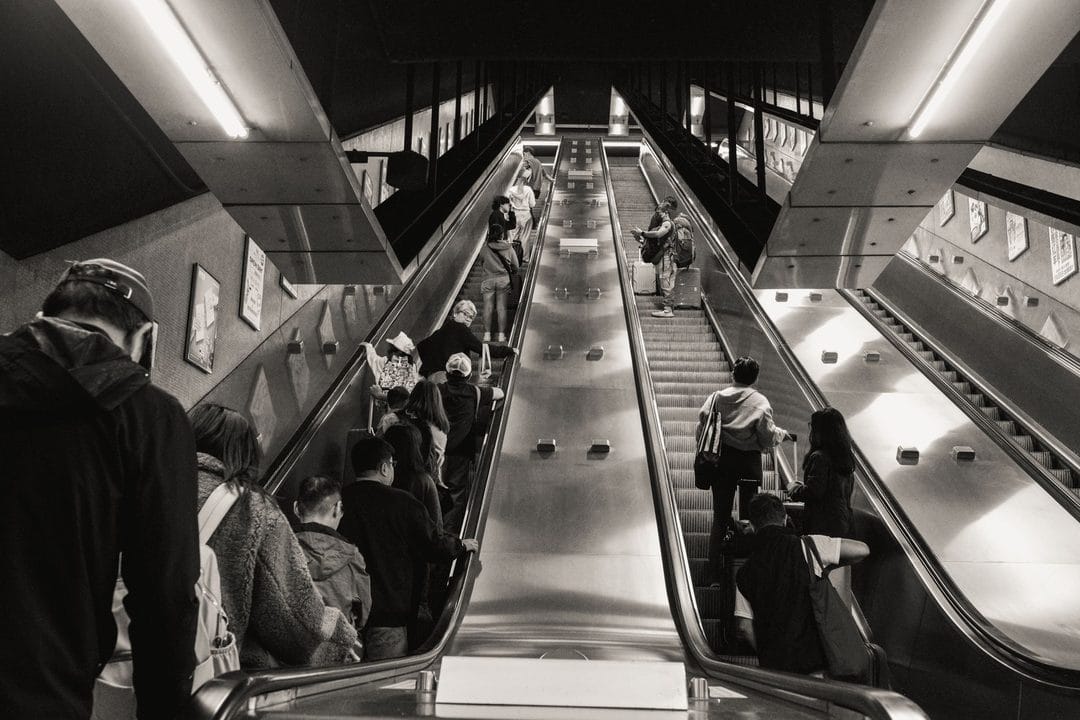
Walk up Cochrane Street in Central on a wet Tuesday morning and you will notice something a planner in most cities would call a mistake: a covered escalator running uphill through the middle of a working neighbourhood, past noodle shops and dry cleaners and a man selling newspapers, with people stepping off at the level that happens to hold their building. The Central-Mid-Levels Escalator has done this since 1993. It climbs about 135 metres of vertical rise over 800 metres of route, it carries somewhere around 85,000 trips on a busy day, and the people riding it are not tourists looking for a view. They are commuters who would otherwise be climbing a gradient that defeats ordinary buses, in heat that makes the climb genuinely unpleasant for half the year. The thing works because it stopped pretending to be a machine and started behaving like a street.
Why a hillside breaks the normal toolkit
The standard urban-transit answer to distance is the bus, the tram, the metro line. None of them handle a steep, dense slope well. A bus needs a road wide enough to turn and a gradient gentle enough that it does not cook its brakes on the way down; a metro tunnel under a hillside is enormously expensive and drops you at fixed stations that may be a hundred vertical metres from your front door. Hong Kong Island, Chongqing on its river bluffs, and the hill districts above Yokohama and Nagasaki all share the same awkward geometry: the places people live sit above the places they work, separated by a slope that is too short to justify a rail line and too steep to walk comfortably with shopping. The escalator slips into exactly that gap.
And it does something the bus cannot. Because it runs continuously and stops at every cross street, it has no timetable to miss and no fixed boarding points to walk to. You join it where you are and leave it where you want. That single property, more than the engineering, is why the Central escalator reshaped the neighbourhood around it rather than just serving it.
The street that grew sideways
Here is the part the original 1993 planners did not predict.
The escalator was built to move government workers down to the business district in the morning and home in the evening, and for its first years that is roughly what it did. Then the ground floors along its path started changing. Rents on the lanes the escalator crossed climbed because suddenly thousands of people passed each shopfront daily at walking pace, eye-level, with nothing to do but look. The district now known as SoHo, the cluster of bars and restaurants on Elgin and Staunton Streets, exists in its current form largely because the escalator created a river of slow-moving foot traffic where there had been a quiet residential slope. The infrastructure did not just carry people through the area. It manufactured the area's commercial value, almost by accident.
This is the strongest argument for treating a hillside escalator as a street rather than as a lift. A lift moves you between two points and the corridor in between is dead space. An escalator at street grade, open to the lanes it crosses, turns its whole length into frontage. Chongqing's longest outdoor escalators, threading up from the riverside districts, have produced the same effect at a larger and rougher scale: small businesses cluster at the landings because that is where the people are.
What the copies get wrong
Plenty of cities have looked at the Hong Kong example and built something that misses the point. The common failure is to build the escalator as a sealed tube with no exits between the bottom and the top, usually because it is cheaper and easier to maintain. That version moves people but creates nothing. Medellin's outdoor escalators in the Comuna 13 hillside are the famous exception that proves the rule, because they were deliberately built with landings that open onto the neighbourhood, and the murals and small commerce that grew around them followed the Hong Kong pattern rather than the sealed-tube one.
There is also a maintenance reality nobody likes to mention. An outdoor escalator running 18 hours a day in subtropical humidity is a demanding machine. The Central system is split into around 20 separate escalator and walkway segments precisely so that one breakdown does not strand the whole route, and even so, sections go out of service for repair regularly enough that locals know which ones to avoid. A single continuous escalator would be elegant and would also be a single point of failure 800 metres long. Segmentation is ugly on paper and correct in practice.
The detail most cities skip
The cover matters more than the escalator.
Hong Kong, Chongqing, Yokohama and Singapore all sit in climates where the choice is rain or heat, often both in the same week. An uncovered escalator is useless in a downpour and punishing under a summer sun, and an escalator people will not use in bad weather is not infrastructure, it is a fair-weather convenience. The Central escalator is fully roofed for its entire length, which is the unglamorous decision that lets it carry the same crowds in June monsoon as in January. If you are going to copy one thing from the Hong Kong model, copy the roof before you copy the escalator. A covered staircase that people actually use beats a beautiful open escalator they avoid four months a year.
The honest caveat is that none of this scales infinitely. An escalator is a one-direction-at-a-time proposition during peak hours, and the Central system runs downhill until 10am and uphill for the rest of the day for exactly that reason. It cannot do what a metro does. What it can do is solve the specific, common, badly-served problem of the steep last 500 metres between a transit stop and a hillside home, and on that narrow problem it has no real competitor. The next Asian city building on a slope should stop asking how to flatten the hill and start asking where to put the roof.