The Asian High-Line: Seoul, Singapore and Tokyo Found Three Different Answers to the Disused Rail Question
Seoul kept the highway honest. Singapore stripped the rail corridor pristine. Tokyo refused the park typology entirely. Three Asian answers to one question.
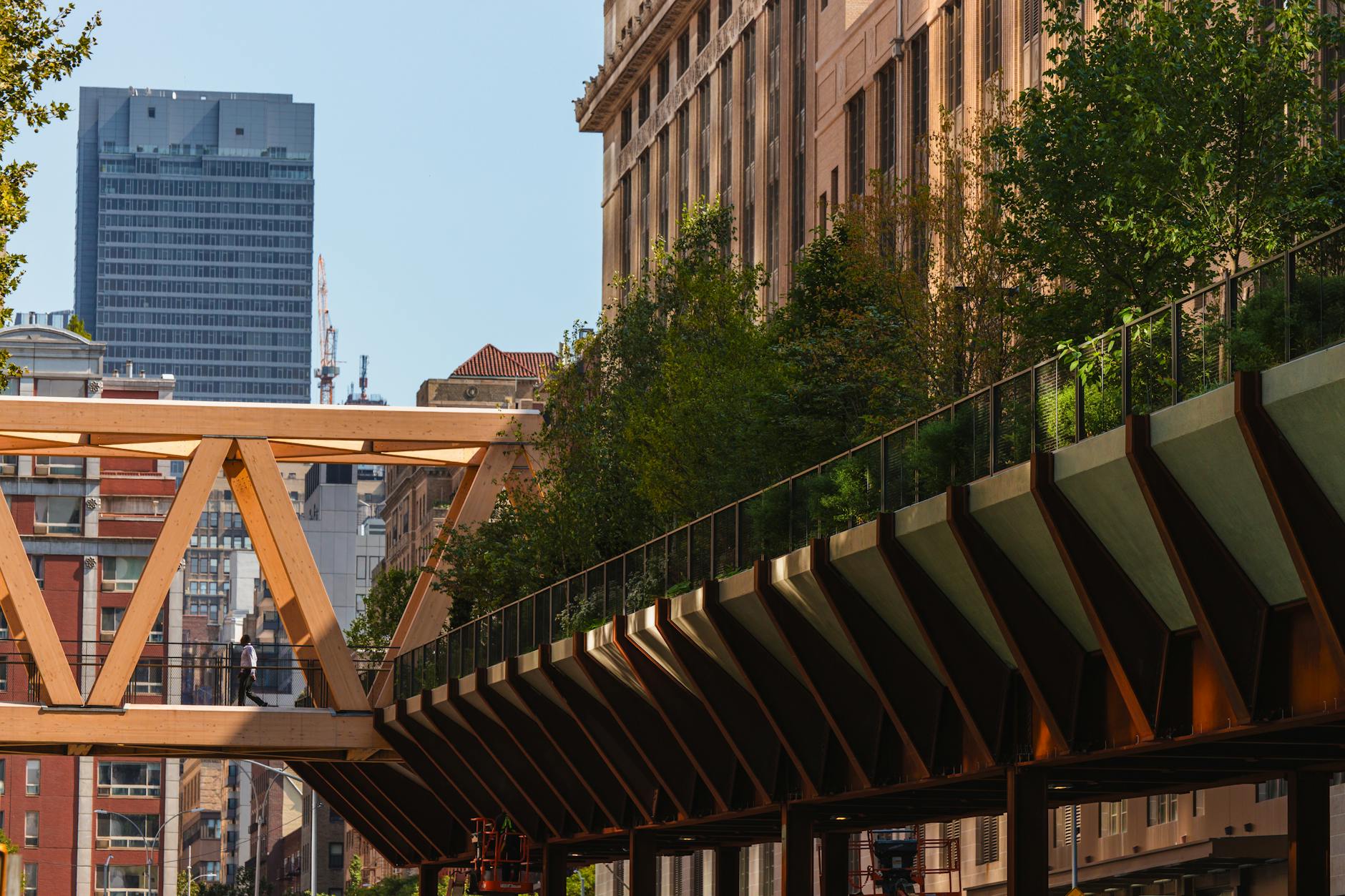
Seoullo 7017 is a freeway. That sentence is technically wrong — the 983-metre concrete ribbon running above Seoul Station has not carried a car since 2015 — but it is the truest thing you can say about the experience of walking it. The width is highway width. The corner radii are highway radii. The handrails are highway handrails painted green. Almost every detail of the original 1970 Seoul Station Overpass was kept in place when the structure reopened in 2017 as the largest piece of elevated public space in East Asia, and the result is a park that has not stopped feeling like a road.
That is, partly, the point. Seoul, Singapore and Tokyo have each converted a piece of disused transport infrastructure into linear public space over the past decade, and each of them refused the Manhattan template. The High Line in New York, which opened in stages from 2009, is the project these three cities are answering against — and they are answering with three completely different theses about what a city does with a piece of architecture it no longer needs.
Seoul: The Honest Conversion
The Seoullo 7017 — the name combines the opening year (2017) and the original construction year (1970) — was designed by MVRDV and opened to the public on May 20, 2017. The brief, written by then-mayor Park Won-soon's office, was almost confrontational: do not pretend this used to be anything other than a freeway. Plant it like a botanical garden, light it like a runway, install a foot bath in the middle, and let the visitor see, at every step, that they are standing on something the city decided to keep.
There are 24,000 plants in 645 concrete pots running the full length of the structure, organised by Korean family name in alphabetical order. The signage is bilingual but does not interpret the experience for the visitor — there is no panel explaining what used to happen here, no historical photographs, no "before and after." The structure is allowed to be itself.
The cafés on the ground level beneath the overpass do most of the work the park itself refuses to do. The best one is Manseondae Coffee in the Malli-dong arch, which runs a small terrace looking up at the underside of the deck. The view is industrial. The coffee is excellent. The park above carries on at full highway width.
Singapore: The Pristine Reconstruction
The Rail Corridor in Singapore is the opposite move. The 24-kilometre track ran from Tanjong Pagar to Woodlands until 2011, when the Malaysian Railway lease expired and the line was decommissioned. The reopening, completed in stages between 2021 and 2024 under URA's Rail Corridor Masterplan, removed the tracks, scrubbed the steel, and laid a 4-metre wide path along the original alignment.
Where Seoul left the bones visible, Singapore restored everything that was original and removed everything that was added later. The 1932 black-and-white Bukit Timah Railway Station was returned to its original colour. The bridges over Bukit Timah Road were stripped to bare metal and repainted in their 1956 specification. The signal box at Tanjong Pagar was rebuilt from the engineering drawings.
The signal box that gives it away
What gives the Singapore move away is the surface underfoot. The original track was ballast — loose stone, sleepers, rails. The current path is permeable concrete dyed to look like compacted laterite, with a thin steel inset every 18 metres to suggest where a rail used to be. It is the most consciously curated long park in the region, and it works precisely because nothing about it is accidental.
The Hindhede Nature Park access point, opened in November 2023, has become the standard test of the route. On a Saturday morning at 7:15 the path carries roughly 400 walkers per hour in each direction. The macaques sit on the railings. The path is wide enough to overtake. Singapore has built the cleanest, most legible linear park in Asia, and it has done so by refusing to let it feel found.
Tokyo: The Disappearing Trick
The Shimokitazawa rail corridor — the line of Odakyu trains that used to run at grade through one of central Tokyo's most popular residential districts — was buried underground in stages between 2013 and 2018. What was left was a 1.7-kilometre corridor of land directly above the tunnel that the railway company, Odakyu Electric, did not know what to do with.
The answer, developed between Odakyu and the Setagaya ward office and largely complete by 2022, is unique in the region: the corridor is not a park. It is a sequence of nine small projects — a bookshop, a daycare, a hostel, an outdoor stage, a community garden, a pop-up retail strip, a covered seating area, a small temple square, and a private restaurant garden — connected by a footpath that nobody markets as a path.
BONUS TRACK, the Bookstore at Kitazawa Station, sits on what used to be platform 2 of the old Shimokitazawa Station. The shelf height is exactly the height of the platform-edge tactile paving, which still runs in a yellow line under the books. The owner, Tomoko Sakai, told the Asahi in a 2023 interview that she negotiated the lease on condition that the paving be left visible.
The Tokyo thesis
The Shimokitazawa approach makes a different argument from Seoul or Singapore. It says: a city has too many parks already. What a freed-up linear strip needs to do is rejoin the urban fabric, not separate from it. The corridor is not a destination. The destinations are the businesses along the corridor, and the corridor is the connective tissue between them. A visitor who does not know the line used to be a railway will walk it for ten minutes and not realise they have passed through what would, in Seoul, be a tourist photograph.
Three Answers to the Same Question
What every Asian city now faces, as its transport patterns shift and its 20th-century infrastructure becomes redundant, is the question of what to do with the leftover ribbons. Seoul kept the structure and called the experience honest. Singapore stripped the additions and called the experience curated. Tokyo refused the linear-park typology entirely and called the experience continuity.
None of the three is the correct answer. Each of them is the correct answer for the city that built it. The error is to assume the Manhattan template — High Line, manicured, photographable, retail-adjacent — is the only one available. Asia's three big linear projects are evidence that there are at least three other options, and probably more.
What unites them is what they all refused to do: pretend the infrastructure was not there. The road, the railway, the platform — each city kept exactly enough of the original to remind the walker what the space used to do for the city, and removed exactly enough to let the walker do something else with it. That balance, more than any planting scheme or design language, is the move worth copying.