Chiang Mai for Digital Nomads Who've Outgrown Bali
Chiang Mai was a digital nomad hub before the phrase existed. Now that the nomad gold rush has passed, something more interesting is emerging.
The Post-Hype City
Chiang Mai went through its digital nomad peak around 2016-2019, when the convergence of rock-bottom costs, excellent wifi, and aggressive social media promotion turned the city into a pilgrimage site for location-independent workers. The Nimman neighborhood, a formerly quiet residential area west of the Old City, transformed almost overnight into a corridor of coworking spaces, Western-style cafes, and restaurants serving the same avocado toast and açaí bowls that the same demographic consumed in Canggu and Lisbon. The 2020 pandemic thinned the crowds, and the burning season—three months of hazardous air quality from agricultural fires that has worsened annually—drove out many of the nomads who'd made it their semi-permanent base. What remains is a city that's absorbed its nomad chapter, retained the infrastructure improvements it produced, and entered a more interesting phase of development.
That phase looks like this: the coworking spaces still operate, but they're less crowded and more diverse in their membership. The cafe scene has evolved from copying Melbourne and Portland to developing its own identity, rooted in northern Thai ingredients and Lanna culture. The art scene, always present but overshadowed by the nomad narrative, has grown in visibility and ambition. And the Old City—the moated square kilometer that contains Chiang Mai's temples, traditional markets, and the dense, walkable streetscape that first attracted visitors centuries before wifi was invented—remains one of the most atmospheric urban environments in Southeast Asia.
The Old City on Foot
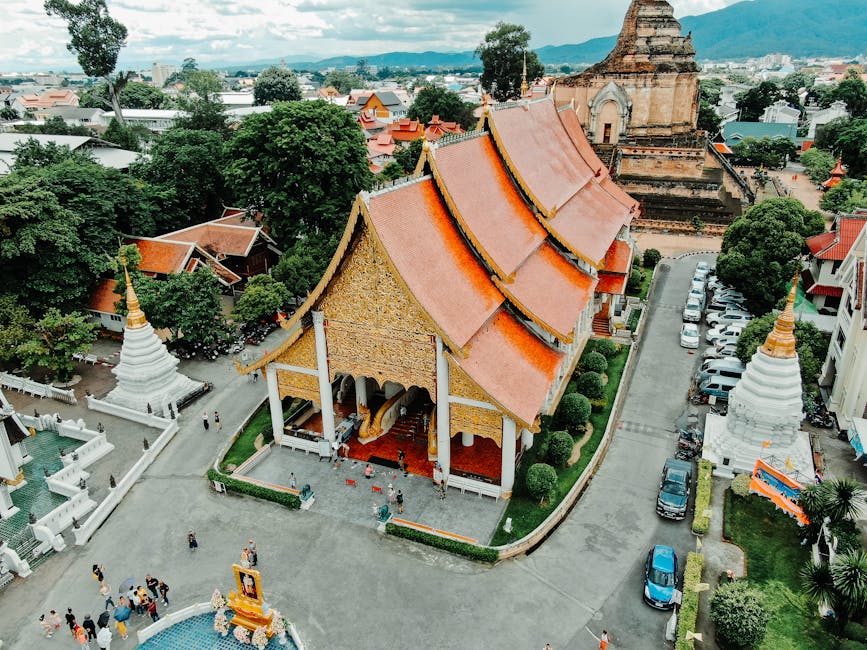
Chiang Mai's Old City is defined by its moat—a rectangular water channel roughly 1.5 by 1.7 kilometers that was part of the original 13th-century fortification system and now functions as a boundary between the historic core and the commercial city surrounding it. Inside the moat, the streets are narrow, the buildings are low, and the density of temples is staggering: over 30 active wats (Buddhist temples) occupy the Old City, meaning you're never more than a five-minute walk from a place of worship, meditation, or architectural wonder.
Wat Chedi Luang, near the center of the Old City, houses the remains of a massive 14th-century chedi (stupa) that was partially destroyed by a 16th-century earthquake and has been left in its ruined state—the broken summit and exposed brick creating a visual effect that's more powerful than any intact structure could achieve. The temple complex also contains the city pillar (lak mueang), a modest structure that is Chiang Mai's spiritual center. Visiting at dusk, when the monks perform evening chanting in the main viharn and the chedi glows in the last light, provides a sense of continuity—this has been happening here for 600 years—that cuts through the contemporary city's noise.
The Sunday Walking Street
The Sunday Walking Street Market, which runs the length of Ratchadamnoen Road from Tha Phae Gate to Wat Phra Singh, is Chiang Mai's most important weekly event and one of the best markets in Thailand. Starting at 4 PM and running until roughly 10 PM, the market fills the Old City's main east-west artery with hundreds of vendors selling handmade goods (textiles, ceramics, wood carvings, silver jewelry), street food (sai ua northern sausage, khao soi, mango sticky rice, grilled meats, fresh coconut ice cream), and artwork (paintings, prints, photography) at prices that reflect the local economy rather than tourist markup. A hand-woven cotton scarf costs ฿200-400 ($5.70-$11.40), a piece of Lanna-style pottery ฿150-500 ($4.30-$14.30), and a plate of sai ua with sticky rice ฿50 ($1.40). The quality is genuinely good—the handicrafts are produced by artisans from Chiang Mai province and the surrounding northern Thai communities—and the atmosphere is festive without being aggressive.
The Food Beyond Khao Soi
Chiang Mai's food scene is significantly more complex than the khao soi narrative suggests, though khao soi (a coconut curry noodle soup with crispy noodle garnish, served with pickled mustard greens and shallots) is indeed excellent here and worth eating multiple times. The northern Thai (Lanna) culinary tradition is distinct from central Thai cooking in ways that most visitors don't immediately register: heavier use of fermented flavors (nam phrik ong, a chili-tomato-pork dip; nam phrik noom, a roasted green chili paste), less coconut milk, more grilled and roasted preparations, and a significant Burmese and Shan influence that reflects the region's border-crossing cultural history.
Huen Phen, a restaurant in the Old City that serves different menus during the day and evening, is the standard reference point for Lanna cuisine. The evening menu, served in a dark, atmospheric dining room cluttered with antiques and Thai decorative objects, includes kaeng hang lay (a Burmese-influenced pork curry with ginger and tamarind), laab mueang (a northern-style minced meat salad that's herbier and less lime-heavy than its Isaan cousin), and sai ua (northern Thai sausage stuffed with lemongrass, galangal, and chili). Dinner for two with beers comes to roughly ฿600-800 ($17-$23), which for this quality and quantity represents one of the great dining bargains in Asia.
The Burning Season Problem
Any honest guide to Chiang Mai must address the burning season, which runs from approximately February through April and produces air quality that the WHO classifies as hazardous to human health. The cause is agricultural burning—farmers in northern Thailand, Laos, and Myanmar clearing fields by fire—combined with Chiang Mai's geography: the city sits in a basin surrounded by mountains that trap smoke like a bowl. During peak burning season (usually March), the AQI regularly exceeds 200, sometimes 300, and the physical effects are immediate: burning eyes, sore throat, reduced visibility to less than a kilometer, and a perpetual haze that turns the sky from blue to a sickly yellow-grey.
The practical implications for visitors and residents are serious. During burning season, outdoor activity becomes inadvisable for anyone with respiratory sensitivity, and even healthy adults should limit exposure. The city's restaurants, cafes, and coworking spaces install air purifiers, but the quality varies—a ฿2,000 purifier in a small cafe is less effective than the ฿50,000 industrial unit at a premium coworking space. Many long-term residents leave Chiang Mai entirely during March and April, retreating to the southern islands, Bangkok, or abroad. If you're planning a stay in Chiang Mai, the optimal months are November through January (cool, dry, clear air) and June through September (rainy season, but the rain clears the air and the landscape turns spectacular green).
Why Chiang Mai Still Works
Strip away the digital nomad marketing and the burning season caveats, and Chiang Mai remains a remarkable city. The Old City provides a walkable, human-scaled urban environment that's increasingly rare in Southeast Asia. The temple culture is living and authentic—monks still collect alms at dawn, temple grounds still function as community gathering spaces, and the sound of bells and chanting still punctuates the day. The food is extraordinary at every price point. The cost of living, while no longer the absurd bargain it was in 2015, remains low enough that a comfortable life costs roughly $1,000-1,500 per month. And the surrounding countryside—Doi Suthep mountain, the rice paddies of Mae Rim, the hot springs of San Kamphaeng—provides natural beauty within thirty minutes of the city center that most cities can't match with an hour's drive.
Chiang Mai's next chapter will be shaped by how the city addresses the burning season (a problem that requires international cooperation and agricultural policy reform, not just local government action), manages tourism growth (which is recovering to pre-pandemic levels), and develops its creative economy (the city's designers, artists, and makers are increasingly producing work for international markets). For visitors willing to come during the right months and engage with the city beyond the coworking spaces, Chiang Mai offers an urban experience that balances modernity and tradition, affordability and quality, with more grace than any other city in Southeast Asia.