The Night Market as Civic Space: Why Asia's Best Public Square Has No Roof and No Entry Fee
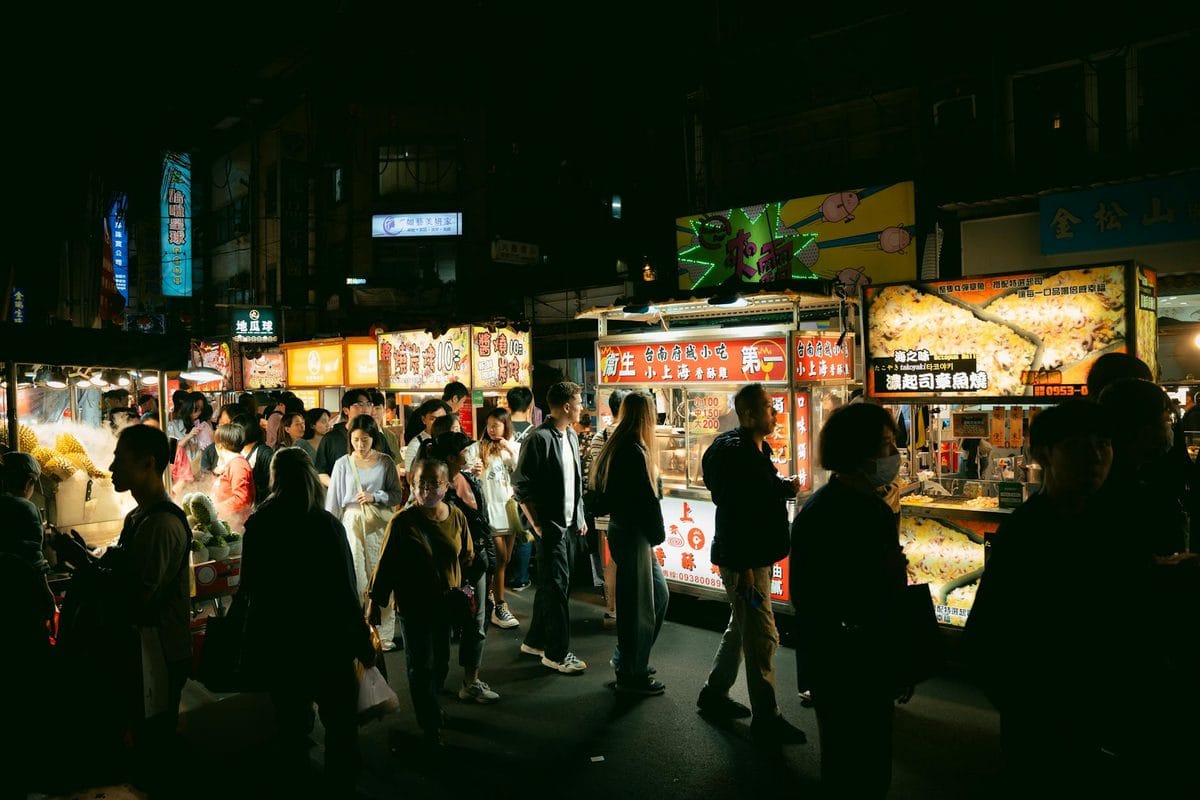
A night market is the one place in an Asian city where the social hierarchy genuinely flattens. The office worker in a suit, the student counting coins, the family with a stroller and the tourist with a phone out all stand in the same queue for the same bowl, paying the same handful of notes. Few pieces of urban space do that, and almost none of them were planned. The night market is infrastructure that grew sideways, out of necessity and habit, and it ended up doing the social work that parks and plazas are supposed to do but rarely manage in dense, hot, expensive cities.
The functional genius of it is the timing. These markets switch on when the heat breaks and the working day ends, claiming streets and lots that serve other purposes during daylight. Taipei built an entire civic identity around this rhythm — Shilin, Raohe, Ningxia — where lanes that are ordinary by noon become the densest social space in the city by nine. The market is not an attraction bolted onto the neighbourhood; it is the neighbourhood, running a second shift.
It works because it is cheap to be there
The night market solves a problem that polished public space usually fails at: it gives people somewhere to exist for hours without spending much. A plaza with a designer fountain still asks you to buy a coffee to justify the chair. A night market lets you walk, look, eat one skewer, sit on a plastic stool and stay — the price of entry is a few dollars and the willingness to stand in a crowd.
That low threshold is exactly what makes it democratic. Compare the alternatives a city offers its residents after dark:
- The shopping mall, climate-controlled and pleasant, but built around the assumption that you are there to spend, and closed by ten.
- The licensed bar district, which sorts people by budget and by who feels welcome walking in.
- The public park, often closed or unlit at night for safety reasons that the night market quietly solves through sheer density of people.
The market beats all three on the metric that matters for social life — how long an ordinary person can comfortably linger without being moved along.
The pressure is mostly from above
Here is the part that gets overlooked: night markets are not dying from lack of demand. They are squeezed by the things cities do as they get richer. Bangkok cleared swathes of street vendors from major thoroughfares in the name of order and pedestrian flow, and the social texture of those blocks changed overnight. Hawker culture in Singapore survives largely because the state formalised it into purpose-built centres, which kept the food but rehoused the chaos — a trade-off that worked, even if something of the original looseness was lost.
So what happens when a city decides its night market is a hygiene problem or a traffic obstruction rather than a public good? Usually the vendors don't vanish, they scatter — into apps, into pop-up weekend markets, into the harder-to-reach edges of the city. The food survives. The accidental commons, the part where strangers shared a street, is the thing that breaks.
The smarter cities have figured out that the market is worth protecting on its own terms, not just preserving as a heritage backdrop. Taiwan treats its night markets as living civic spaces with real political constituencies. Vietnam's night economies in Hanoi and Saigon run on a similar understanding — that the value is in the gathering, not only the grilling.
If you want to understand a city after dark, skip the rooftop bar with the entry list. Find the lane where the plastic stools spill into the street and the steam never stops, and watch who is there. It will be everyone. That is the whole point, and it is harder to build on purpose than any city planner likes to admit.