Green Corridors and Urban Parks: How Asian Cities Are Building Breathing Room
Seoul buried a highway to create a stream. Singapore connected every park with a green corridor. These aren't cosmetic changes — they're rewriting how cities breathe.
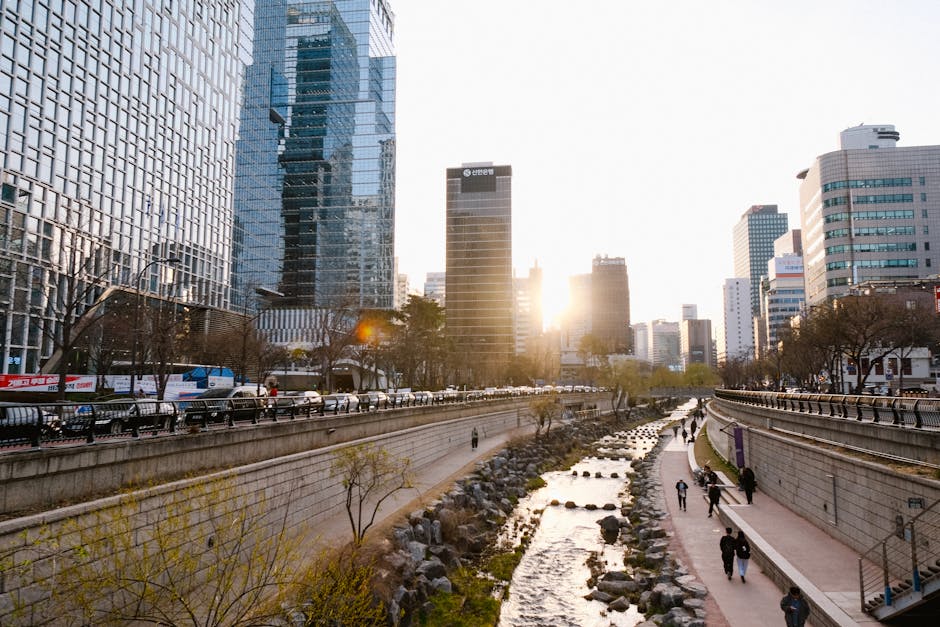
The Highway That Became a Stream
In 2003, Seoul's newly elected mayor Lee Myung-bak did something that urban planners globally considered either visionary or insane: he demolished the Cheonggye Expressway, a 5.8-kilometer elevated highway that had run through the center of the city since 1976, and restored the Cheonggyecheon stream that the highway had buried. The project cost ₩386 billion ($290 million), took two years, and produced a linear park that's now one of the most visited public spaces in Asia—a 5.8-kilometer ribbon of flowing water, landscaped banks, pedestrian paths, and public art that runs from Gwanghwamun in the west to the Jungnangcheon in the east, right through the heart of Seoul's commercial district.
The results exceeded projections by every measure. Ambient temperatures along the stream corridor dropped by 3.6°C compared to nearby streets. Biodiversity increased dramatically: species of fish, birds, and insects returned to a waterway that had been dead for three decades. Property values along the corridor rose by 20-30% within five years. Bus ridership in the area increased by 15% as commuters shifted from cars to public transit. And foot traffic—the most basic indicator of a public space's success—exceeds 64,000 people per day, making Cheonggyecheon one of the most-used linear parks in the world.
The philosophical significance is as important as the practical outcomes. Cheonggyecheon demonstrated that a highway—the 20th century's symbol of progress and mobility—could be dismantled and replaced with something better. The idea that urban infrastructure is permanent, that the decisions of previous generations must be accepted as given, was revealed as a choice rather than a constraint. Other cities took notice: the Skygarden (Seoullo 7017) project, which converted an abandoned highway overpass near Seoul Station into an elevated park, followed the same logic, turning automotive infrastructure into pedestrian space with results that, while less dramatic than Cheonggyecheon, contribute to a cumulative reimagining of what Seoul's streets are for.
Singapore: The City in a Garden
Singapore's approach to urban greening is characteristically systematic, well-funded, and ambitious in scale. The city-state's stated goal—to transform from a "garden city" to a "city in a garden"—isn't just branding; it represents a genuine policy commitment backed by billions of dollars in investment and a regulatory framework that requires new developments to replace any greenery they destroy with equivalent or greater green space, often on rooftops, facades, or elevated platforms.
The Park Connector Network is the infrastructure that makes this philosophy tangible. Over 360 kilometers of cycling and walking paths link Singapore's major parks—East Coast Park, Bishan-Ang Mo Kio Park, MacRitchie Reservoir, the Southern Ridges—in a continuous green network that allows residents to move between parks without encountering major roads. The most impressive section, the Coast-to-Coast Trail, stretches 36 kilometers from Jurong Lake Gardens in the west to Coney Island in the northeast, passing through park connectors, nature reserves, and urban neighborhoods in a route that demonstrates Singapore's commitment to making green space accessible rather than decorative.
Gardens by the Bay, the 101-hectare park on reclaimed land adjacent to Marina Bay Sands, is Singapore's most visible green space and its most architecturally ambitious. The Supertree Grove—eighteen vertical gardens ranging from 25 to 50 meters tall, connected by an elevated walkway—is the park's icon, and the experience of walking the OCBC Skyway between the Supertrees at dusk, when the structures illuminate and the light show begins, is one of the great urban landscape experiences in any city. The two conservatories—Cloud Forest and Flower Dome—maintain ecosystems from cloud forests and Mediterranean climates respectively, using a cooling system that's powered partly by biomass energy from the park's own horticultural waste.
The HDB Green Factor
Singapore's most impactful urban greening isn't in the parks but in the Housing Development Board (HDB) estates where 80% of the population lives. The Skyrise Greenery Incentive Scheme provides funding for rooftop gardens, green facades, and elevated planting on HDB buildings, and the results are visible across the island: apartment blocks wrapped in trailing plants, rooftop vegetable gardens maintained by resident committees, and corridor gardens where neighbors tend plants together. These interventions are modest individually—a few hundred square meters of greenery per building—but collectively they add thousands of hectares of green space to the urban environment, distributed where people actually live rather than concentrated in destination parks.
Tokyo: The Pocket Park Philosophy
Tokyo's approach to urban green space is defined by its constraints: the city is among the most densely populated on Earth, land values make large parks economically impossible in most neighborhoods, and the existing park system, anchored by imperial properties (Shinjuku Gyoen, the Imperial Palace grounds, Meiji Jingu), provides significant green space but in locations that are destinations rather than daily-use amenities. The solution, evolved over decades of incremental policy, is the pocket park—small green spaces inserted into the urban fabric wherever opportunity allows.
Tokyo's park system includes over 8,000 parks, but the majority are smaller than a basketball court. These tiny parks—playground equipment, a bench, a water fountain, a few trees—serve a function that larger parks cannot: they provide rest, shade, and nature within walking distance of virtually every residence in the city. A Tokyo resident is never more than five minutes on foot from a park, which is a remarkable achievement for a city of 14 million and a metric that most other cities of comparable density can't approach.
The larger parks deserve attention for what they do differently. Inokashira Park in Kichijoji, centered on a lake surrounded by cherry trees and zelkova, functions as the living room of its neighborhood—a space where families picnic, couples paddle swan boats, and street musicians perform on weekends with the unspoken understanding that the park belongs to everyone and the experience is free. The High Line-inspired Minami-Ikebukuro Park, opened in 2020 on former railway land in Toshima Ward, demonstrates a newer approach: elevated green space integrated with retail and community facilities, designed less for relaxation than for transit—a green corridor that people walk through on their way somewhere, absorbing nature as an incidental benefit rather than a destination experience.
Why This Matters
Urban green space in Asian cities isn't a luxury or an amenity—it's infrastructure, as essential as water supply or electrical grids, with measurable returns in public health (reduced cardiovascular disease, lower obesity rates, improved mental health), property values (15-30% premiums for properties near parks), economic activity (increased foot traffic and retail spending in areas with pedestrian green corridors), and climate resilience (reduced urban heat island effect, improved stormwater management). The cities that are investing in green infrastructure now—Seoul, Singapore, Tokyo—are not doing so for aesthetic reasons. They're doing so because the evidence demonstrates that green space makes cities healthier, wealthier, and more resilient, and because the cost of not investing—in healthcare, in climate adaptation, in the social consequences of living in environments that are hostile to human wellbeing—exceeds the cost of the parks by orders of magnitude.
The highway that became a stream in Seoul didn't just create a park. It proved that cities can undo their mistakes, that infrastructure decisions are reversible, and that the bold, expensive, politically risky choice to prioritize people over cars can produce outcomes that nobody—not even the politicians who championed it—fully predicted. Every green corridor built since, in every Asian city, carries a trace of that proof.