The Modern Skylines of Asia: Glass, Steel, and What They Say About Us
A skyline is a city's autobiography written in glass and steel. Asia's skylines are writing new chapters faster than any other region, and the stories they tell are complicated.
Skylines as Statements
Every major Asian city built or rebuilt its skyline in the past fifty years, which means the vertical profile of each city is a conscious choice rather than an inherited accident. New York's skyline accumulated over a century through the decisions of thousands of individual developers; Shanghai's Pudong skyline was planned, commissioned, and executed in roughly two decades as a deliberate statement of national ambition. This distinction matters because it means Asian skylines can be read as texts—each building a sentence, the overall composition a narrative about what the city (and the nation) wants to communicate about its identity, its values, and its place in the world.
Shanghai: The Ambition Skyline
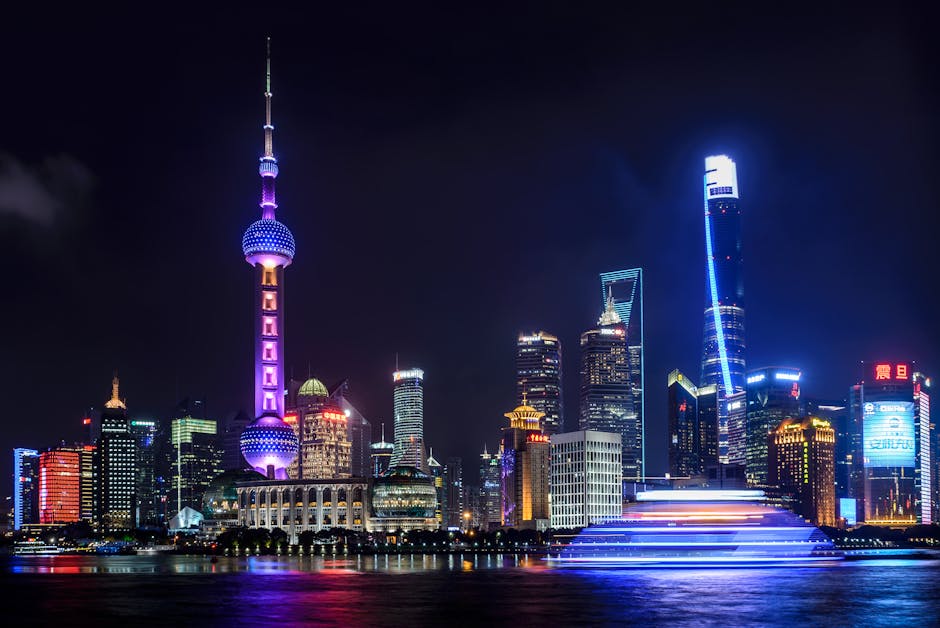
Pudong's skyline, viewed from the Bund across the Huangpu River, is the most dramatic urban panorama built in the 21st century. The progression from the Oriental Pearl Tower (1994, with its retro-futuristic spheres) through Jin Mao Tower (1999, a pagoda-influenced Art Deco skyscraper by SOM) to the Shanghai World Financial Center (2008, the "bottle opener" designed by KPF) to Shanghai Tower (2015, the twisting 632-meter supertall by Gensler) traces China's evolution from tentative modernizer to confident architectural patron over twenty years. Each building is larger, bolder, and more technically accomplished than its predecessor, and the cumulative effect is a skyline that communicates raw ambition—the desire to build higher, faster, and more spectacularly than any city has built before.
The Pudong skyline works as spectacle but less well as urban fabric. At street level, the spaces between the towers are wind-swept plazas and elevated walkways that feel deserted compared to the density of the Puxi side across the river. The buildings speak to the world; the ground plane speaks to almost nobody. This is the paradox of ambition-driven skyline building: the higher the towers, the more impressive the view from a distance, and the less pleasant the experience of actually walking among them.
Singapore: The Curated Skyline
Singapore's Marina Bay skyline is perhaps the most carefully designed urban silhouette in the world—every building's height, form, and position was subject to regulatory review and urban design guidelines that treat the skyline as a collective composition rather than a collection of individual projects. The result is a skyline that reads as intentional rather than competitive: the three towers of Marina Bay Sands (with their connecting SkyPark) anchor the western end, the Esplanade's durian-shaped domes occupy the center, and the financial district's glass towers provide a vertical rhythm along the eastern horizon. The coherence is remarkable—each building is distinct but none overwhelms its neighbors, and the overall effect is a skyline that communicates competence, control, and a level of civic design ambition that most cities can only aspire to.
The Green Dimension
Singapore's skyline is increasingly defined not just by its towers but by the greenery on and around them. The Supertrees at Gardens by the Bay have become the city's most recognizable icons—more recognizable, arguably, than any individual skyscraper—and their vertical-garden form has influenced a wave of green-facade buildings that are changing the skyline's texture. Parkroyal on Pickering, an office-and-hotel building by WOHA Architects, wraps its facade in planted terraces that contain over 15,000 square meters of gardens—more green space than the building's ground-floor footprint. CapitaSpring, a skyscraper in the financial district, includes a four-story "Green Oasis" at its midsection that functions as a public garden suspended 17 stories above the street. These buildings suggest a direction for Asian skylines that moves beyond height competition toward ecological integration—towers that participate in the city's green infrastructure rather than merely rising above it.
Hong Kong: The Organic Skyline
Hong Kong's skyline is the accidental masterpiece—a vertical landscape that nobody designed as a whole but that, through the cumulative decisions of developers constrained by extreme geography (mountains behind, harbor in front, limited buildable land), has produced one of the world's most visually compelling urban profiles. The Symphony of Lights show, which illuminates the skyline nightly with laser beams and colored lights, is garish and touristy, but the underlying skyline—viewed from the Star Ferry, from Victoria Peak, or from the Tsim Sha Tsui promenade—requires no enhancement. The buildings rise in irregular, densely packed ranks from the harbor's edge, climbing the steep hillside behind in a gradual wave that makes the skyline appear to be growing out of the mountain rather than sitting on flat ground.
Hong Kong's skyline also illustrates the tension between architectural ambition and commercial pragmatism. The Bank of China Tower (1990, I.M. Pei)—a crystalline, angular form that was Hong Kong's tallest building when completed—is a genuine architectural achievement, its geometric form creating a visual presence that dominates the Central skyline despite being shorter than several newer neighbors. The International Commerce Centre (2010, KPF), at 484 meters Hong Kong's current tallest, is technically competent but architecturally forgettable—a glass box elevated to supertall height without the formal ambition that Pei brought to the Bank of China. The skyline's beauty comes not from individual buildings but from their collective density, variety, and relationship to the extraordinary natural landscape that frames them.
Tokyo and Seoul: The Restrained Approach
Tokyo's skyline is notably restrained for a city of its size and economic power. Earthquake engineering requirements, strict building codes, and a cultural ambivalence toward height that reflects Shinto and Buddhist architectural values have produced a skyline that's horizontal rather than vertical—a vast, low-rise expanse punctuated by occasional clusters of towers in Shinjuku, Marunouchi, and Shibuya. The Tokyo Skytree (634 meters, the world's tallest tower) is an outlier—a broadcasting tower rather than a building—and its isolation against the low-rise cityscape emphasizes how different Tokyo's vertical profile is from Shanghai's or Hong Kong's. The beauty of Tokyo's skyline is in its depth rather than its height: seen from Tokyo Tower or Roppongi Hills, the city extends to the horizon in every direction, a texture of rooftops, streets, and parks that communicates scale through extent rather than altitude.
Seoul's skyline has grown more assertive in recent years, with Lotte World Tower (555 meters, completed 2017) providing a focal point that the city previously lacked. But Seoul's most interesting vertical architecture isn't its tallest—it's the Dongdaemun Design Plaza (which plays with horizontal curves rather than vertical height), the Samsung D'Light building in Gangnam (whose LED facade makes it a building-sized screen), and the growing number of adaptive-reuse projects that convert old industrial buildings into culturally significant spaces. Seoul's skyline is still being written, and the most interesting chapters are coming not from supertall competitions but from projects that treat the vertical dimension as one element of a more complex urban composition.
What Skylines Tell Us
Asian skylines, collectively, tell a story about the relationship between ambition and identity. Shanghai's skyline says: "We can build anything." Singapore's says: "We can plan anything." Hong Kong's says: "We've been building on this impossible terrain for 150 years and we're not done." Tokyo's says: "Height isn't the only way to be powerful." The next chapter—already being written in projects that prioritize green integration, mixed-use programming, and cultural significance over pure height—suggests that Asian cities are beginning to ask not just "how tall can we build?" but "what should we build, and why?" The answer to that question, played out in glass and steel against tropical skies and mountain backdrops, will define the skylines that the next generation inherits.