The Onsen Experience: A Foreigner's Guide to Japanese Hot Springs
You will be naked. Everyone else will be naked. The water will be too hot. You will think about leaving. Thirty minutes later, you will understand why Japan has built an entire culture around sitting in hot water.
The First Three Minutes
Here's what happens the first time you visit a Japanese onsen: you walk into the changing room, you look at the other bathers who are already undressed, you briefly consider leaving, you undress anyway, you pick up the small wash towel, you walk through the door to the bathing area, and for approximately three minutes you experience the most acute self-consciousness of your adult life. Your brain, conditioned by decades of Western modesty norms, is shouting that this is wrong—you're naked, in public, in front of strangers, and the small towel you're holding is useful for washing but comically inadequate for covering anything. Then minute four arrives. You sit on a washing stool, you shower, you soap yourself with the thoroughness that onsen etiquette demands, you rinse completely, and you lower yourself into the hot water. The water is 40-42°C (104-108°F), which is hotter than your body expects and produces an initial gasp followed by a spreading warmth that reaches your muscles, your joints, and eventually your capacity for self-consciousness. By minute ten, the nudity is irrelevant. By minute twenty, you've forgotten you're wearing anything less than your usual amount of clothing. By minute thirty, you understand why Japan has 27,000 onsen facilities and why the culture treats hot-spring bathing as a practice rather than an activity.
The Rules (Non-Negotiable)
Onsen etiquette is simple, absolute, and non-negotiable. Violating it will draw stares, corrections from staff, and in serious cases, being asked to leave. The rules exist to maintain the hygiene and atmosphere of a shared bathing space, and they're taken seriously because the alternative—dirty water, uncomfortable bathers, degraded experience—is unacceptable in a culture that treats communal bathing as a centuries-old social institution.
Rule one: wash thoroughly before entering any pool. This means a full shower with soap, including hair, at the washing stations provided in the bathing area. The wash stations include stools, showerheads, soap, and shampoo. You sit on the stool, you wash everything, you rinse completely—no soap residue can enter the onsen water. This isn't a quick rinse; it's a proper washing, and other bathers will notice if you skip it. Rule two: no swimwear. Onsen are used naked. This applies to Japanese and foreign bathers equally, and facilities that allow swimwear are not true onsen—they're water parks or theme pools. Rule three: the small towel stays out of the water. You may bring your wash towel to the pool area, but it goes on your head, on the pool edge, or anywhere except in the water. Rule four: no loud conversation. Onsen are quiet spaces, and while gentle conversation is fine, the atmosphere should be contemplative rather than social. Rule five: tattoos are often prohibited. This is the rule that most affects foreign visitors, as many Japanese onsen ban tattoos due to their historical association with yakuza. Attitudes are slowly changing—some onsen now provide skin-colored patches to cover small tattoos, and a growing number have dropped the ban entirely—but checking a facility's policy before visiting remains essential.
The Tattoo Question
The tattoo ban deserves expanded comment because it's the primary barrier between foreign visitors and onsen culture. The rule is rooted in a specific historical context: the yakuza (Japanese organized crime) traditionally use full-body tattoos (irezumi) as markers of membership and status, and onsen historically banned tattoos to prevent yakuza from using facilities as meeting or recruitment spaces. The association between tattoos and criminality has weakened significantly among younger Japanese people, who are increasingly getting tattoos for aesthetic rather than affiliative reasons, but the ban persists at many traditional onsen due to institutional inertia and the desire to avoid confrontation.
For tattooed visitors, the options are: private onsen rooms (kashikiri-buro, available at most ryokan and some public facilities for ¥3,000-8,000 per hour), onsen that explicitly welcome tattoos (a list maintained by tattoo-friendly.jp), and onsen in areas with high foreign visitation (Hakone, Beppu) that have relaxed their policies. The most tattoo-tolerant facilities tend to be larger, more modern operations rather than small traditional bathhouses.
Near Tokyo: The Best Day Trips
Tokyo itself has over 700 sentō (public bathhouses) and onsen facilities, but the best onsen experiences require a short trip into the surrounding countryside, where natural hot spring water and outdoor bathing pools (rotenburo) provide an experience that urban facilities can't replicate. Hakone, accessible in 90 minutes by Odakyu Romance Car from Shinjuku, is the most popular destination, with hundreds of onsen ryokan (traditional inns with hot spring baths) ranging from budget (¥8,000 per night including bathing and dinner) to extreme luxury (¥80,000+ at properties like Gora Kadan). The day-use option at Hakone Yuryo (¥1,500 weekdays, ¥1,800 weekends) provides access to indoor and outdoor pools, a sauna, and a relaxation lounge overlooking the Sukumo River, all without requiring an overnight stay.
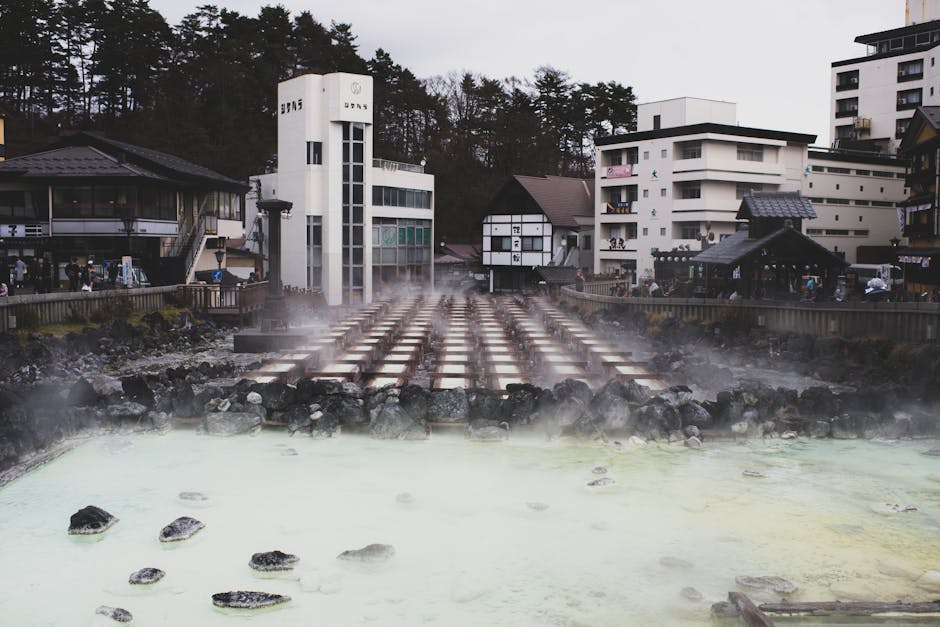
Kusatsu Onsen, about three hours from Tokyo by train and bus, is arguably the finest onsen town in Japan. The water, which flows at 32,000 liters per minute from natural springs, has the highest natural acidity of any Japanese onsen and is traditionally "cooled" by the yumomi (hot-water stirring) technique—teams of bathers use wooden paddles to churn the water, reducing its temperature from 65°C to a batheable 42-44°C. The Sainokawara Open-Air Bath, Kusatsu's largest rotenburo, occupies a rocky riverside setting surrounded by forest, with a pool large enough for fifty bathers and an atmosphere that makes the three-hour journey feel like a reasonable price of admission.
What the Water Does
Japanese onsen classification distinguishes between water types based on mineral content: sulfur springs (sulfur smell, skin-softening), sodium chloride springs (saltwater, warming), iron springs (rust-colored, circulation-boosting), and roughly ten other categories, each claimed to have specific therapeutic properties. The scientific evidence for these specific claims is mixed—hot water immersion demonstrably reduces muscle tension, improves circulation, and promotes relaxation, but whether sulfur water specifically benefits skin conditions more than plain hot water remains debated. What's not debated is the subjective experience: an hour in a good onsen, particularly a rotenburo where you're soaking outdoors surrounded by nature, produces a state of physical and mental relaxation that is qualitatively different from a hot bath at home. The mineral content, the water temperature, the absence of chlorine, and the social context all contribute to an experience that the Japanese describe as "naked communion" (hadaka no tsukiai)—a state of vulnerability and ease that facilitates both introspection and genuine social connection.
The after-bath state—clean, warm, deeply relaxed, slightly light-headed from the heat, wrapped in a cotton yukata—is one of the great physical pleasures available to a human body. Walking from the onsen to a ryokan dinner table in this state, sitting on tatami, and being served a multi-course kaiseki meal while your body radiates residual warmth and your mind is temporarily emptied of urgency is an experience that justifies the entire trip, the initial awkwardness, and the three hours on a bus from Tokyo. The water does something that intellectual arguments about etiquette and cultural openness cannot: it makes you feel good enough that the discomfort of getting there stops mattering entirely.