Pet-Friendly Spaces in Asian Cities: Where Your Dog Is Actually Welcome
Traveling with a dog in Asia ranges from surprisingly easy to genuinely complicated. Here's where your pet is welcome, where it's tolerated, and where you should make other arrangements.
The Pet Boom Context
Pet ownership in Asian cities has surged over the past decade in a way that urban infrastructure hasn't kept pace with. South Korea's pet population exceeded 6 million in 2024—roughly one pet for every nine residents—up from 3.5 million in 2015. Japan has more pets than children under 15. Singapore's dog population has doubled since 2010. This growth, driven by the same demographic forces that fuel the co-living and loneliness-economy trends (rising single-person households, delayed marriage, declining birth rates), has created demand for pet-friendly urban spaces that cities are addressing with varying degrees of enthusiasm and success.
Seoul: Most Pet-Friendly in Asia
Seoul has emerged as Asia's most pet-friendly major city, with infrastructure and cultural attitudes that have shifted remarkably in the past five years. The city now has over 40 designated off-leash dog parks, with the best located along the Han River—the Banpo Hangang Park dog run and the Yeouido Hangang Park dog park both offer fenced areas with separate zones for small and large dogs, water stations, and waste disposal facilities. The parks are free, well-maintained, and busy on weekends with a mix of breeds and owners that reflects Seoul's diverse dog-ownership demographics.
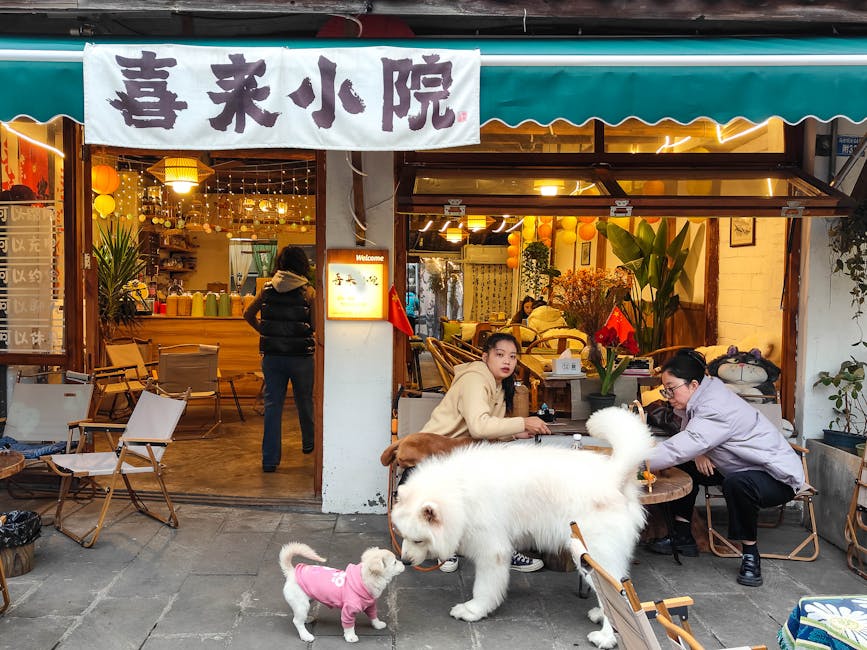
Pet-friendly cafes and restaurants have multiplied in Seoul to the point where they're no longer a novelty but a standard option. Neighborhoods like Mangwon, Yeonnam-dong, and Seongsu-dong have particularly high concentrations of dog-welcome establishments, with outdoor seating areas that accommodate dogs and some indoor spaces that allow small dogs. The trend has been supported by Korean food safety regulations that were revised in 2023 to permit dogs in designated areas of restaurants, a change that was controversial but has been broadly implemented. Water bowls at the entrance of a restaurant or cafe signal pet-friendliness, and asking "강아지 괜찮아요?" (gangaji gwaenchanayo?—is a dog okay?) is the standard inquiry.
Seoul's public transit policy for pets is the most permissive in Asia: dogs are allowed on the metro and buses if carried in a carrier or worn in a carrier bag. The size limit is approximately 5 kilograms, which excludes most medium and large breeds, but for small dogs, the ability to navigate the city by transit with your pet makes Seoul uniquely functional as a pet-friendly city. Taxis are hit-or-miss—many drivers accept small dogs, some refuse—but Kakao T (the ride-hailing app) allows pet-friendly driver requests.
Tokyo: Polite Coexistence
Tokyo's pet culture is extensive but more restrained than Seoul's, reflecting the broader Japanese tendency toward consideration for shared spaces. Dogs are ubiquitous in residential neighborhoods—the morning dog-walking routine in areas like Daikanyama, Jiyugaoka, and Kichijoji fills the streets with Toy Poodles, Shiba Inus, and Miniature Dachshunds in numbers that suggest every household has at least one—but the infrastructure for taking dogs into commercial and public spaces is more limited. Most restaurants don't permit dogs, even outdoors, though an increasing number of cafes with outdoor seating (terrace-seki) welcome them. Pet-friendly cafes that explicitly invite dogs indoors (not to be confused with dog cafes, where the dogs belong to the business) exist in Daikanyama, Omotesando, and Shimokitazawa but aren't yet as numerous as in Seoul.
Tokyo's parks vary in dog policy. Yoyogi Park, the city's most popular weekend gathering space, allows leashed dogs on most of its grounds and has an unofficial off-leash area near the northwest corner that dog owners use by consensus rather than official permission. Komazawa Olympic Park has a formal dog run (¥500 day pass) with separate small/large dog areas. Kinuta Park in Setagaya also has a designated dog area. The quality of these facilities is high—Japan's general standard of park maintenance applies equally to dog parks—and the user culture is notably responsible: plastic bags, hand sanitizer, and the immediate cleanup of waste are universal expectations rather than suggestions.
Transit With Pets
Dogs on Tokyo trains must be fully enclosed in a carrier that doesn't exceed standard luggage dimensions (roughly 70cm x 90cm x the sum of three sides under 250cm). A pet ticket (手回り品切符, temawarihin kippu) costs ¥290 on JR lines, while Tokyo Metro and most private railways don't charge extra for pets in carriers. The practical implication is that small dogs travel easily on Tokyo transit, while medium and large dogs require car transportation—a significant limitation in a city where driving is impractical for most residents.
Singapore: Regulated Friendliness
Singapore's pet policies reflect the city-state's characteristic approach: clearly regulated, consistently enforced, and designed to balance competing interests (pet owners vs. non-pet-owning neighbors, animal welfare vs. public hygiene). Dogs are permitted in all public parks and Park Connectors on leash, with dedicated off-leash dog runs at Bishan-Ang Mo Kio Park, West Coast Park, and Punggol Waterway Park. The dog runs are well-designed—separated by size, with water stations and double-gated entry systems—and maintained to the standard Singaporean benchmark of cleanliness.
HDB (public housing) regulations restrict dog ownership in apartments to one dog of an approved breed, with a maximum weight of 15 kilograms—a policy that effectively prohibits most medium and large breeds in a country where 80% of the population lives in HDB flats. Private condominiums set their own pet policies, which vary from pet-friendly to no-pets-allowed. This regulatory framework shapes Singapore's pet-ownership demographics: the city has a disproportionate number of small dogs (Poodles, Maltese, Shih Tzu) relative to larger breeds, and the pet-friendly infrastructure is designed accordingly.
Bangkok: Informal Acceptance
Bangkok's pet-friendliness is less regulated and more culturally determined than in the other cities listed. Thailand has a generally positive cultural attitude toward dogs (soi dogs—street dogs—are a ubiquitous part of Bangkok's streetscape, fed and loosely cared for by neighborhood communities), and this tolerance extends to pet dogs in commercial spaces. Many cafes and restaurants, particularly in the Thonglor, Ekkamai, and Ari neighborhoods, welcome dogs at outdoor tables without formal policy—the Thai approach is to accommodate rather than regulate. Benjakitti Park and Lumpini Park both allow leashed dogs, and the weekend scene at Benjakitti in particular includes a substantial dog-owner contingent that has created an informal social community.
The challenge in Bangkok is veterinary care quality, which ranges from excellent (Thongnopakhun Animal Hospital, Bangkok Pet Hospital) to inadequate at smaller neighborhood clinics. Pet owners planning extended stays should establish a relationship with a quality veterinary practice early, particularly for vaccinations, parasite prevention, and the heat-related health risks that affect dogs less acclimated to tropical temperatures.
The Practical Takeaways
For pet owners living in or visiting Asian cities: Seoul is the best overall, with the most pet-friendly infrastructure, the most welcoming cultural attitude, and the most functional transit policy. Tokyo is excellent for small-dog owners who don't need transit for their pets and who appreciate quality park facilities. Singapore is clean and well-regulated but restrictive for larger breeds. Bangkok is informal and accommodating but requires more self-reliance on veterinary care and pet safety. For all cities, carrying cleanup supplies, keeping dogs leashed in public unless in designated off-leash areas, and reading the room before bringing your dog into a restaurant are universal practices that keep the relationship between pet owners and non-pet-owning neighbors functional in densely populated urban environments.