Street Art in Asian Cities: Walls That Talk Back
Asian street art exists in a space between government permission and creative rebellion, and that tension produces work that's more interesting than either impulse alone.
Permission and Rebellion
Street art in Asia operates under conditions that differ fundamentally from the European and American contexts where the movement originated. In cities like Singapore, where unauthorized graffiti carries criminal penalties including caning, or Tokyo, where the social stigma of public defacement is arguably more powerful than any legal sanction, street art cannot exist as pure rebellion the way it does in Berlin or São Paulo. Instead, it occupies a negotiated space between official permission (government-commissioned murals, developer-sponsored installations) and creative insurgency (sticker art, paste-ups, guerrilla interventions in spaces nobody's watching). This negotiation produces work that's more considered, more political in its subtlety, and more visually sophisticated than the anything-goes approach of cities where nobody cares what you paint on a wall.
George Town, Penang: The Mural Capital
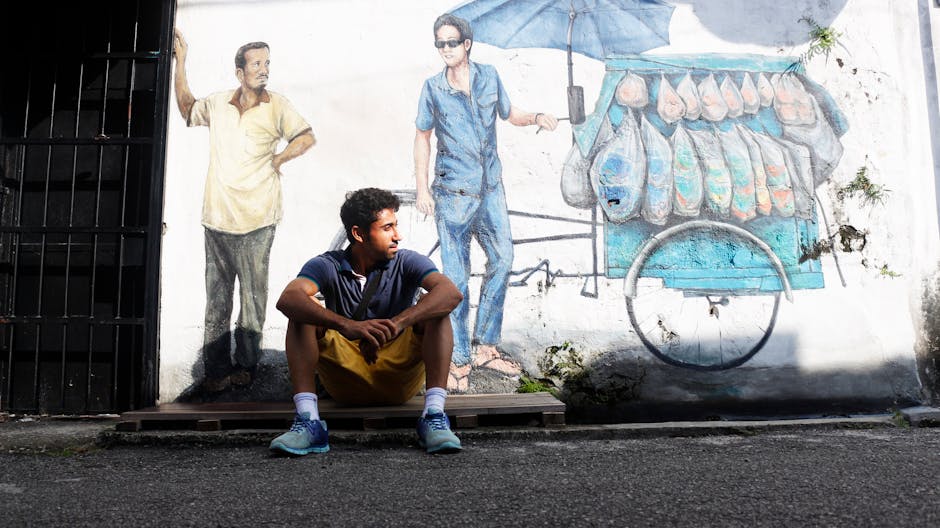
George Town, Penang's UNESCO World Heritage capital, has the most concentrated and most celebrated street art scene in Southeast Asia, anchored by Lithuanian artist Ernest Zacharevic's 2012 series of murals commissioned as part of the George Town Festival. The most famous—"Children on a Bicycle," painted on Armenian Street—depicts two children on a real bicycle frame welded to the wall, their painted bodies merging with the physical object in a way that's playful, technically skilled, and perfectly integrated into the heritage shophouse facade. The mural draws tens of thousands of visitors annually and has spawned a cottage industry of street art tourism that extends across the city's historic core.
Beyond Zacharevic's commissioned works, George Town's street art scene includes over 100 murals, iron-rod caricatures by local sculptor Tan Leong Chye that illustrate George Town's multicultural history, and a growing body of work by Malaysian and international artists who've been drawn to the city's supportive atmosphere and photogenic streets. The art is spread across the heritage zone, concentrated on Armenian Street, Cannon Street, Lebuh Acheh, and the lanes branching off Penang Road. A self-guided walking tour takes three to four hours and functions as both an art tour and a heritage tour, because the murals frequently reference the buildings they're painted on and the communities that inhabit them.
The tension in George Town is between street art as cultural expression and street art as tourist infrastructure. The murals have unquestionably increased tourism revenue and raised the city's international profile, but they've also contributed to the gentrification of the heritage zone—rising rents have displaced longtime residents, and the streets that Zacharevic painted are now lined with cafes and souvenir shops rather than the provision stores and family homes that gave them their original character. The murals celebrate a way of life that they're simultaneously helping to displace, which is an irony that George Town shares with every neighborhood where art has preceded gentrification.
The Iron-Rod Sculptures
Tan Leong Chye's iron-rod caricatures deserve specific attention because they represent a form of street art that's unique to George Town. Installed across the heritage zone, these flat iron sculptures depict scenes from the city's history—a trishaw rider, a fisherman, a family at a kopitiam—with accompanying text in English and Malay that explains the historical context. They're subtle enough that you might walk past them without noticing, which is appropriate for art that tells the quiet stories of ordinary life rather than the dramatic narratives of commissioned murals.
Tokyo: The Subtle Approach
Tokyo's street art scene is the least visible and arguably the most interesting in Asia, because the social and legal constraints force creativity into formats that would be unnecessary in more permissive cities. Large-scale unauthorized murals are almost nonexistent—the social cost of defacing property in Japan is severe enough that even counterculture figures rarely attempt it. Instead, Tokyo's street art operates through stickers (thousands of them, layered on utility poles, vending machines, and construction barriers in Shibuya, Harajuku, and Shimokitazawa), paste-ups (wheat-paste prints applied to walls and removed before they attract official attention), and the occasional authorized mural in neighborhoods like Koenji and Nakano where property owners have given explicit permission.
The sticker culture is Tokyo's most distinctive contribution to street art. Artists like Shiro and ESSU produce limited-edition stickers that function as miniature artworks—screen-printed, hand-drawn, or digitally printed on weatherproof vinyl—and distribute them through trades, direct sales, and the simple act of sticking them in public. The concentration of stickers on the utility poles of Shibuya's Cat Street or the construction barriers around Harajuku station creates a cumulative visual effect that's more collage than graffiti, a democratic art exhibition where entry requires nothing more than a sticker and the willingness to place it. The stickers are removed periodically by city maintenance crews, which gives the scene a built-in ephemerality that's strangely appropriate for a city that treats impermanence as a cultural value.
Hong Kong and Taipei: Political Walls
Street art in Hong Kong acquired a political dimension during the 2019 protests that it had never previously carried. Lennon Walls—surfaces covered with Post-it notes bearing political messages—appeared across the city, from the underpasses of Admiralty to the stairwells of residential buildings. The walls were repeatedly cleared by authorities and repeatedly rebuilt by protesters, creating a cycle of expression and erasure that made the act of placing a Post-it note a political statement far beyond the content of its message. Since 2020, political street art in Hong Kong has become extremely rare due to the national security law, but the Lennon Wall precedent demonstrated how quickly street art can shift from aesthetic practice to political resistance when conditions demand it.
Taipei's street art scene is concentrated in the Ximending district, a pedestrian shopping area in Wanhua where murals, graffiti, and paste-ups occupy an entire lane known informally as Graffiti Alley. The work ranges from skillful large-scale pieces by established Taiwanese artists to amateur tags and stencils, and the overall effect is more chaotic and more energetic than George Town's curated approach. Taipei's relatively permissive attitude toward street art—police generally ignore work in designated areas, and property owners in Ximending actively invite artists to paint their walls—creates an environment where quantity is high and quality varies, which purists may find frustrating but which produces an authentic, evolving visual landscape rather than a static exhibition.
The Commissioned vs. Organic Debate
Every major street art scene in Asia faces the same philosophical question: is commissioned, permitted street art still street art, or has it become outdoor advertising with better aesthetics? The question matters because the answer shapes policy. If street art is valuable only when it's organic and unauthorized, then regulating it destroys its value. If street art is valuable regardless of its authorization status, then cities can commission and curate it as a cultural asset. Most Asian cities have chosen the second interpretation, commissioning murals and designating legal painting zones while maintaining penalties for unauthorized work. This produces a street art landscape that's more controlled and less raw than what you'd find in Berlin or Bogotá, but it also produces work that's often more technically accomplished, more culturally specific, and more integrated into the urban fabric than the spray-and-run approach of unregulated scenes.
The honest answer is that both approaches have value and neither has a monopoly on quality or authenticity. The best street art in Asia—Zacharevic's George Town murals, Tokyo's sticker collages, the Lennon Walls of Hong Kong—succeeds not because of its relationship to authority but because of its relationship to place: it says something about where it is, who lives there, and what matters to them, in a format that's public, accessible, and impossible to ignore. Whether the artist had permission matters less than whether the wall talks back.