Thai Massage, Done Right: A Guide to Finding the Real Thing in Bangkok
The ฿200 massage parlor near Khao San Road will crack your back and waste your money. A real Thai massage, from a skilled practitioner, will change how your body feels for days.
The Quality Spectrum
Bangkok has approximately 5,000 registered massage establishments and an unknown number of unregistered ones. The quality range across these operations spans from world-class traditional healing that draws patients internationally to assembly-line operations where undertrained staff perform rushed routines on tourists who don't know the difference. The price range is correspondingly wide: a one-hour traditional Thai massage costs from ฿200 ($5.70) at a sidewalk shop to ฿3,500+ ($100+) at a luxury spa, and neither extreme necessarily correlates with quality. Some of the best Thai massage in Bangkok costs ฿400-600 ($11.40-$17.10) at unassuming neighborhood shops where the therapists have decades of training and the price reflects the local economy rather than the tourist economy. Some of the worst costs ฿2,500+ at hotel spas where the environment is beautiful and the massage is forgettable.
Understanding Traditional Thai Massage
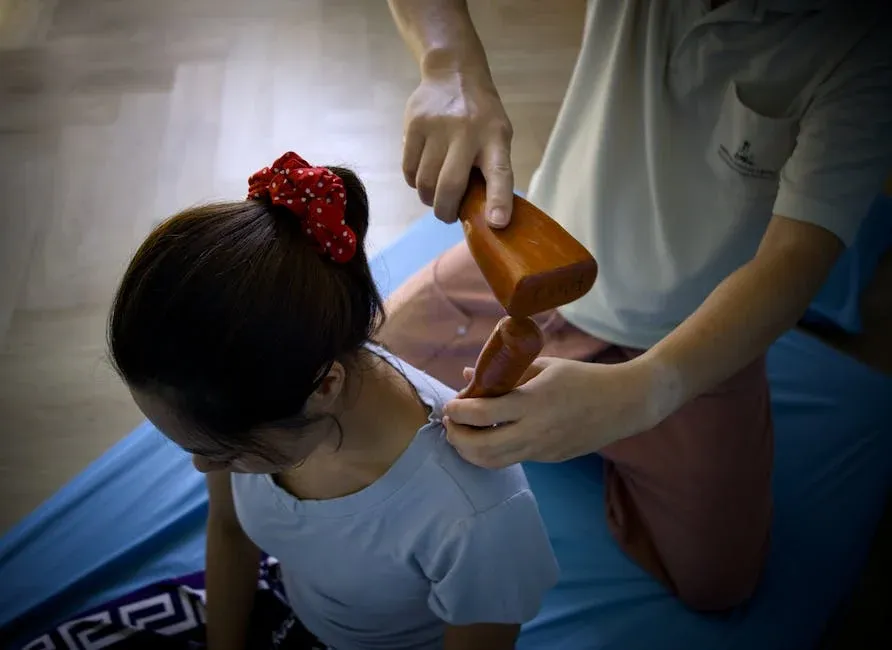
Nuad Thai (นวดไทย), traditional Thai massage, is a therapeutic practice with roots in Ayurvedic medicine and Buddhist spiritual practice, codified in Thailand over centuries and inscribed on UNESCO's Intangible Cultural Heritage list in 2019. It's distinct from Swedish, Balinese, or shiatsu massage in both technique and philosophy. The practitioner uses hands, elbows, knees, and feet to compress, stretch, and mobilize the recipient's body along sen lines (energy pathways analogous to Chinese meridians), with the recipient wearing loose clothing on a floor mat rather than lying on a table with oils. A proper Thai massage session—typically 1-2 hours—moves through the entire body systematically, beginning with the feet and legs, progressing to the back and arms, and concluding with the neck, head, and face.
The experience, particularly for first-timers, can be intense. Thai massage involves assisted stretching that puts your body into positions it may not have visited since childhood—deep hip openers, spinal twists, shoulder mobilizations—and the pressure applied during compression work ranges from firm to genuinely uncomfortable. Communication with the therapist is essential: "jep" (hurt) or "bao-bao" (lighter) are the two Thai words that will most improve your massage experience, and a skilled therapist will check your comfort level throughout the session rather than applying a standard intensity to every body.
Wat Pho: The Source
Wat Pho (Temple of the Reclining Buddha) is the traditional center of Thai massage education, housing the Wat Pho Thai Traditional Medical and Massage School, which has trained practitioners since 1955. The on-site massage pavilion provides one-hour traditional Thai massage for ฿480 ($13.70) and foot massage for ฿420 ($12), administered by therapists who have completed the school's 800-hour training program. The experience is authentic, the quality is consistent (though individual therapist skill varies, as it does everywhere), and the setting—within the temple grounds, surrounded by the ornate architecture and the faint sound of chanting from the nearby prayer hall—adds a dimension that commercial spas cannot replicate.
Where to Go
Beyond Wat Pho, the best Thai massage in Bangkok is found at establishments that invest in therapist training, maintain reasonable session lengths (never less than one hour for a full-body treatment), and serve a predominantly Thai clientele—which indicates quality valued by people who know what good massage feels like.
Health Land Spa, with multiple locations across Bangkok (the Sathorn and Ekkamai branches are easiest to reach by BTS), is the best mid-range option: two hours of traditional Thai massage for ฿650 ($18.60) in clean, comfortable, air-conditioned rooms. The therapists are professionally trained, the facilities are well-maintained, and the experience is consistently good in a city where consistency is the hardest quality to find. Reservations are recommended on weekends and evenings; walk-ins are usually possible on weekday afternoons.
Ruen-Nuad Massage Studio, in a traditional Thai house in the Silom area, offers a more intimate experience: two hours of Thai massage for ฿500 ($14.30) in a wooden house with garden, where the atmosphere is peaceful and the therapists include practitioners with 20+ years of experience. The house itself—a traditional raised wooden structure with verandas and a small garden—creates an environment that transports you out of Bangkok's urban intensity before the massage begins.
At the premium end, Divana Nurture Spa in Sukhumvit offers a Thai massage experience that integrates herbal compresses, aromatherapy, and post-massage herbal tea in a setting designed for maximum relaxation. Two hours costs ฿3,200 ($91.40), which is expensive by Bangkok standards but includes a level of environmental design—the lighting, the scent, the sound, the temperature—that amplifies the therapeutic effect. The therapists are among the best in the city, and the herbal compress work—heated bundles of Thai herbs pressed into the body along the sen lines—adds a dimension to traditional massage that standard treatments don't include.
Red Flags and How to Avoid Them
The markers of a massage shop to avoid: therapists who use phones during the session, treatment rooms that are loud or visible to passersby, "happy ending" signage or implication (a legitimate Thai massage establishment will never offer this), sessions shorter than the time purchased (a "one-hour" massage that begins and ends in 45 minutes is a scam), and locations that employ aggressive touts who grab your arm on the sidewalk. Legitimate massage shops don't need to physically intercept potential customers, and the quality of a shop is often inversely proportional to the aggressiveness of its marketing.
The final recommendation is simple: book a two-hour session rather than one hour. One hour is enough for a relaxation massage, but traditional Thai massage is a systematic, full-body practice that requires time to work through the entire body properly. In one hour, a therapist must rush; in two hours, the pace can be proper—the stretches can be held longer, the compressions can be deeper, and the overall experience shifts from a pleasant rubdown to something that genuinely reorganizes your body's tension patterns and leaves you feeling different—looser, lighter, more aligned—for days afterward. That difference, between a nice massage and a transformative one, is worth the extra ฿200-300. Your body will know it, even if your mind has already moved on to the next thing.