Why Asian Cities Make Better Third Places
The sociologist Ray Oldenburg coined 'third place' for the spaces between home and work where community happens. He should have spent more time in Asian cities.
Oldenburg's Theory Meets Asian Practice
In 1989, sociologist Ray Oldenburg published "The Great Good Place," arguing that healthy communities require "third places"—informal public gathering spots that are neither home (the first place) nor work (the second place). His examples were European cafes, American diners, British pubs: spaces where people from different backgrounds could meet as equals, linger without spending much money, and build the social connections that make neighborhoods into communities. The theory was influential and remains relevant, but Oldenburg's frame of reference was overwhelmingly Western, and applying it to Asian cities reveals both the theory's universality and its cultural blindspots. Asian cities don't just have third places—they have more varied, more accessible, and more deeply integrated third places than most Western cities, because the cultural conditions that produce them (dense populations, small apartments, strong community norms) are more favorable.
The Asian Third Place Ecosystem
Western third places tend to be commercial: a coffee shop, a bar, a bookstore. You enter, you buy something, and the purchase justifies your presence. This model works but creates an implicit financial barrier—the price of a latte determines who can access the space and how long they can stay. Asian cities supplement commercial third places with a range of non-commercial or minimally commercial spaces that lower the financial barrier and broaden the social reach of communal gathering.
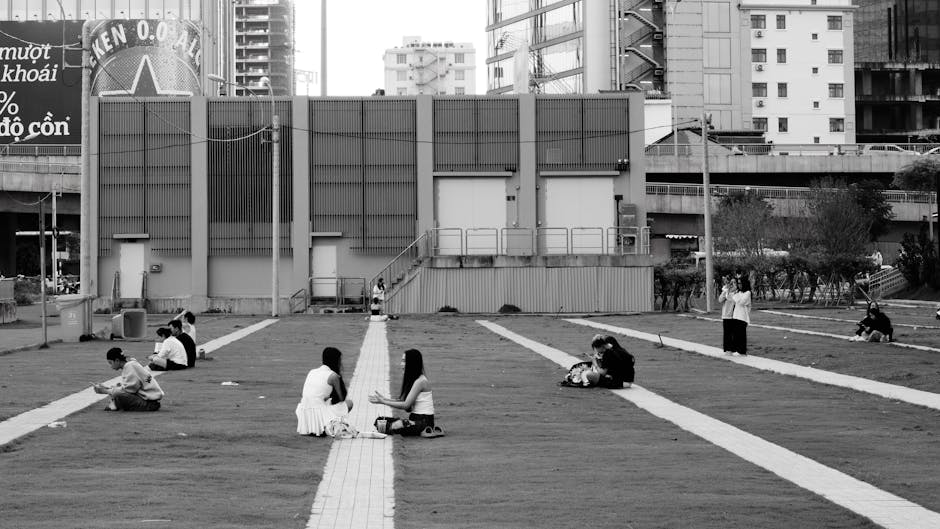
The jjimjilbang (Korean bathhouse) charges ₩12,000-20,000 admission and then allows unlimited stay—sleep, eat, bathe, socialize—without additional mandatory spending, creating a third place accessible to anyone who can afford the entry fee. The Japanese sentō (public bathhouse) costs ¥520 for a bath and unlimited lingering in the communal area. Singapore's void decks are completely free public spaces beneath residential blocks. Bangkok's temple courtyards are open to anyone and function as community gathering spaces with no commercial dimension whatsoever. Taipei's parks offer free public exercise equipment, creating fitness-based third places that require nothing beyond showing up.
These spaces aren't accidents—they're products of cultural values that treat communal gathering as a public good rather than a commercial opportunity. Korean culture has a concept of jeong (정), the emotional bond that forms between people who share space over time. Japanese culture has ibasho (居場所), the sense of belonging to a place. Both concepts assume that people need places to be together, and that providing those places is a social responsibility rather than a market opportunity.
The Convenience Store as Third Place
The most underappreciated third place in Asian cities is the convenience store. Japanese konbini (7-Eleven, FamilyMart, Lawson) provide seating areas, wifi, clean restrooms, and an ever-changing selection of food and drink at prices that make a 30-minute visit cost ¥300 or less. Korean convenience stores (CU, GS25, 7-Eleven) add outdoor seating, beer and wine sales, and microwave access for instant meals, creating informal gathering spaces where students study, workers eat lunch, and couples share a cheap dinner on plastic chairs that, despite their aesthetic limitations, provide a genuine social function. The convenience store third place is available 24 hours, located within walking distance of virtually every residence in cities like Tokyo and Seoul, and requires no social performance—you can be anonymous, scruffy, tired, or alone without judgment. It's the most democratic third place in the most expensive cities on Earth.
Cafes: The Universal Adapter
Asian cafe culture deserves recognition as the world's most developed third-place infrastructure, for reasons that go beyond coffee quality. The average dwell time at a Seoul cafe exceeds 90 minutes—roughly triple the American equivalent—because Korean cafes are designed for lingering. The tables are large enough to work at, the wifi is fast, the power outlets are abundant, and the social expectation is that a ₩5,000 coffee purchase entitles you to stay as long as you want. This isn't generosity; it's a business model built on the understanding that long dwell times create atmosphere, atmosphere attracts customers, and the revenue from a steady stream of long-staying customers exceeds the revenue from a faster turnover of quick visitors.
Tokyo's kissaten tradition adds a dimension that newer cafe cultures lack: the kissaten is a third place with a curatorial function. The owner selects the music, determines the atmosphere, and cultivates a community of regulars whose shared appreciation of the space creates bonds that extend beyond the walls. A regular at a Tokyo jazz kissaten isn't just a customer—they're a member of a community defined by shared taste, and the kissaten's role in maintaining that community is as important as its role in serving coffee.
Why It Works
Asian cities produce better third places because the conditions that third places require—dense populations, small living spaces, cultural emphasis on communal gathering, and available public or low-cost commercial space—are more intensely present in Asian urban environments than in their Western counterparts. When apartments are 25 square meters, people need spaces to be outside their homes. When neighborhoods are dense, the walk to a third place is measured in minutes, not car rides. When cultural norms value communal presence—sitting together, eating together, existing in shared space—the demand for gathering spaces is continuous and the supply responds accordingly.
The lesson for other cities isn't to import specific Asian third-place formats (jjimjilbang won't work in Minnesota) but to recognize the principle they embody: that human wellbeing requires spaces for non-transactional gathering, that providing those spaces is as important as providing roads and utilities, and that the best third places aren't designed as third places—they're designed as spaces that welcome human presence, and the community follows. The Japanese garden, the Korean bathhouse, the Singapore void deck, the Taipei park with its free exercise equipment—none of these were conceived as solutions to loneliness or social fragmentation. They were conceived as places where people could be, and the being-together that happens within them is the most important thing any city can facilitate.