Brutalist Architecture in Asia: Concrete Monsters Worth Loving
Brutalism never asked to be loved, which is exactly why these raw concrete buildings across Asia deserve more than a passing glance from a taxi window.
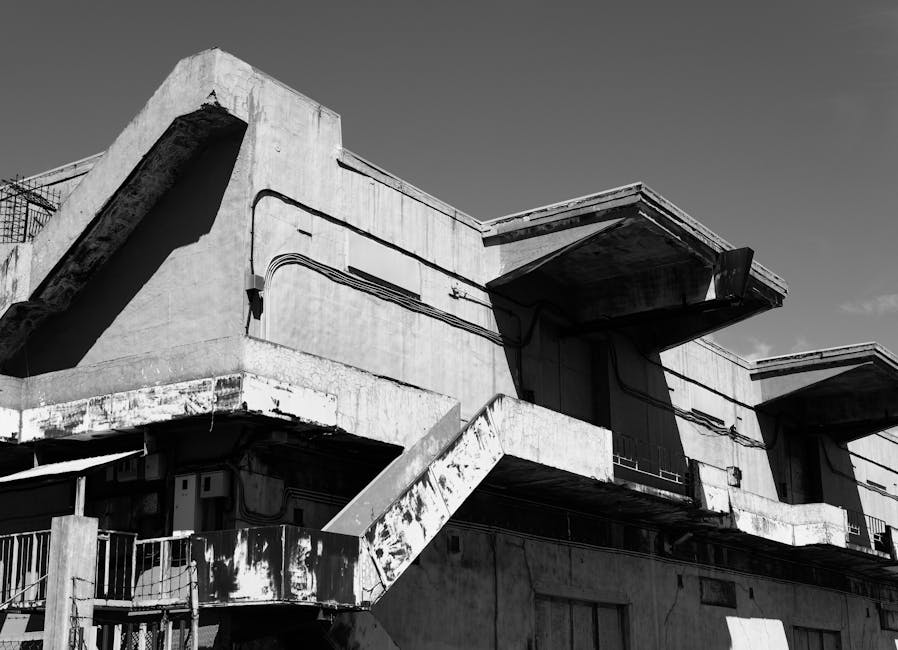
Concrete Doesn't Apologize
The word "brutalist" comes from béton brut—raw concrete—not from "brutal," though the misunderstanding is so widespread that it might as well be intentional. Brutalist architecture, which emerged in the 1950s and peaked in the 1970s, was an honest architecture in the most literal sense: it showed you exactly what it was made of, hid nothing behind cladding or decoration, and trusted that structural logic could produce beauty without cosmetic assistance. In Asia, where the movement arrived alongside postcolonial nation-building and rapid urbanization, brutalism took on additional significance. These buildings weren't just architectural statements; they were declarations of modernity, of independence, of the belief that a newly sovereign nation could build its own future out of reinforced concrete and uncompromising geometry.
India: Where Brutalism Became National Identity
No discussion of Asian brutalism can begin anywhere other than Chandigarh, the city that Le Corbusier designed from scratch as the capital of Punjab after Partition. The Capitol Complex—comprising the Secretariat, the High Court, and the Legislative Assembly—is the most significant brutalist ensemble in Asia and possibly the world, a UNESCO World Heritage Site since 2016 that continues to function as a working government center rather than a museum piece. The Secretariat stretches 254 meters long and stands eight stories tall, its concrete brise-soleil facade creating a pattern of light and shadow that changes hourly and makes the building feel alive despite its monumental scale. Visiting during monsoon season, when water collects in the reflecting pools and the concrete darkens to near-black, transforms the complex into something almost primordial.
Beyond Chandigarh, Indian brutalism flourished in the hands of architects who adapted the movement to local conditions with varying degrees of success. Balkrishna Doshi's Indian Institute of Management in Bangalore (1977-1992) uses exposed concrete and brick in interlocking geometric forms that create shaded courtyards and naturally ventilated corridors—brutalism engineered for a tropical climate rather than imposed on it. The Hall of Nations in New Delhi, built for the 1972 International Trade Fair with a space-frame roof of interconnected concrete tetrahedrons, was one of the most innovative structures of its era. Its demolition in 2017, carried out at night despite widespread protests, remains one of modern architecture's most infuriating losses. The Indian government replaced it with a convention center of surpassing mediocrity, which says something about the relationship between power and aesthetic courage.
The IIT Campuses
India's Indian Institutes of Technology, built in the 1960s and 1970s with assistance from various international partners, contain some of the most underappreciated brutalist architecture in Asia. IIT Delhi's campus, designed by Jugal Kishore Choudhury with input from American architect Joseph Allen Stein, features dormitory blocks and academic buildings in exposed concrete and red brick that have aged with remarkable grace. The integration of covered walkways, courtyards, and water features creates microclimates within the campus that reduce the need for air conditioning—a practical achievement that the buildings' severe appearance might lead you to overlook. IIT Kanpur, designed by Achyut Kanvinde, applies a more explicitly Le Corbusian vocabulary, with pilotis, ribbon windows, and rooftop terraces that reference the master's work while responding to the Gangetic plain's extreme heat.
Japan: Metabolist Dreams and Concrete Poetry
Japanese brutalism took a distinctly philosophical turn through the Metabolist movement, which proposed architecture as a biological process—buildings that could grow, transform, and replace their parts like living organisms. The movement's most famous artifact, Kisho Kurokawa's Nakagin Capsule Tower in Tokyo (1972), was demolished in 2022 after decades of deterioration, but its influence persists in the DNA of Japanese architecture. The tower's 140 prefabricated capsules, each measuring 2.3 by 3.8 meters and intended to be replaceable, were never actually replaced, which either proves the concept was ahead of its time or ahead of its budget. Several capsules were preserved and relocated to museums and private collections, functioning as architectural time capsules of a future that never quite arrived.
What did survive, and what continues to shape Tokyo's architectural identity, is the work of Tadao Ando, who took brutalism's material honesty and refined it into something approaching spiritual practice. Ando's Church of the Light in Osaka (1989) uses concrete walls pierced by a cross-shaped aperture to create a space where light itself becomes architectural material—a cruciform beam that moves across the interior throughout the day. His Row House in Sumiyoshi (1976), a narrow concrete insertion into a traditional Osaka row house neighborhood, provoked neighbors and critics alike with its refusal to accommodate, offering no windows to the street and requiring residents to cross an open-air courtyard to move between rooms. It's deeply impractical and deeply beautiful, and the client has lived there for nearly fifty years, which suggests that architecture which demands something of its inhabitants can reward them in ways that comfortable buildings don't.
Southeast Asia: Tropical Brutalism
The challenge of brutalism in tropical climates—where raw concrete absorbs heat, stains with mold, and becomes physically unpleasant to touch—produced some of the movement's most inventive adaptations. In Singapore, the Golden Mile Complex (1973), designed by a collective of local architects influenced by both Team X and the Metabolist movement, steps upward in a terracing ziggurat form that allows natural ventilation through the entire 16-story structure. The building was slated for demolition but received conservation status in 2021 after a sustained campaign by preservation advocates, and its current restoration aims to retain the raw concrete aesthetic while upgrading systems that have deteriorated over five decades.
In Bangkok, the Baiyoke Tower I (1987) and the adjacent Baiyoke Tower II (1997) represent a late-brutalist approach to the tropical skyscraper, with facade treatments that manage solar gain through deeply recessed windows and projecting concrete fins. Neither building is architecturally refined—they're products of pragmatism rather than theory—but they demonstrate that brutalism could adapt to commercial real estate with more success than the movement's critics typically acknowledge. More compelling is Sumet Jumsai's Robot Building (1986), technically a postmodern design but one whose concrete-and-glass facade, shaped like an enormous robot, shares brutalism's willingness to be confrontational, ridiculous, and memorable all at once.
Why Preservation Matters Now
Asian brutalist buildings face a convergence of threats: aging infrastructure, government indifference, developer appetite for the land they occupy, and a popular perception that concrete buildings are ugly by definition. The demolition of Nakagin, the near-loss of Golden Mile, and the destruction of Delhi's Hall of Nations demonstrate how quickly these buildings can disappear—often replaced by structures that nobody will fight to preserve in fifty years. What gets lost isn't just concrete but the ideas that the concrete embodied: the belief that public buildings should express civic ambition, that architecture can shape social behavior, and that beauty and honesty are not opposing values.
The counterargument—that these buildings are expensive to maintain, energy-inefficient, and sometimes genuinely hostile to their occupants—has merit. Not every brutalist building deserves saving, and nostalgia is a poor basis for preservation policy. But the best examples, from Chandigarh's Capitol Complex to Ando's Row House to Golden Mile's terraced mountain of concrete, represent achievements that cannot be replicated. They were built in a moment of confidence and ambition that has largely passed, and their survival depends on whether the cities they inhabit can recognize that confidence as something worth preserving, even when—especially when—it takes a form that refuses to be pretty.