Night Markets as Social Spaces: Why Asia's Best Nightlife Has No Dress Code
The best night out in Taipei costs less than a single cocktail in Singapore and involves zero bouncers, zero reservations, and an unreasonable amount of stinky tofu.
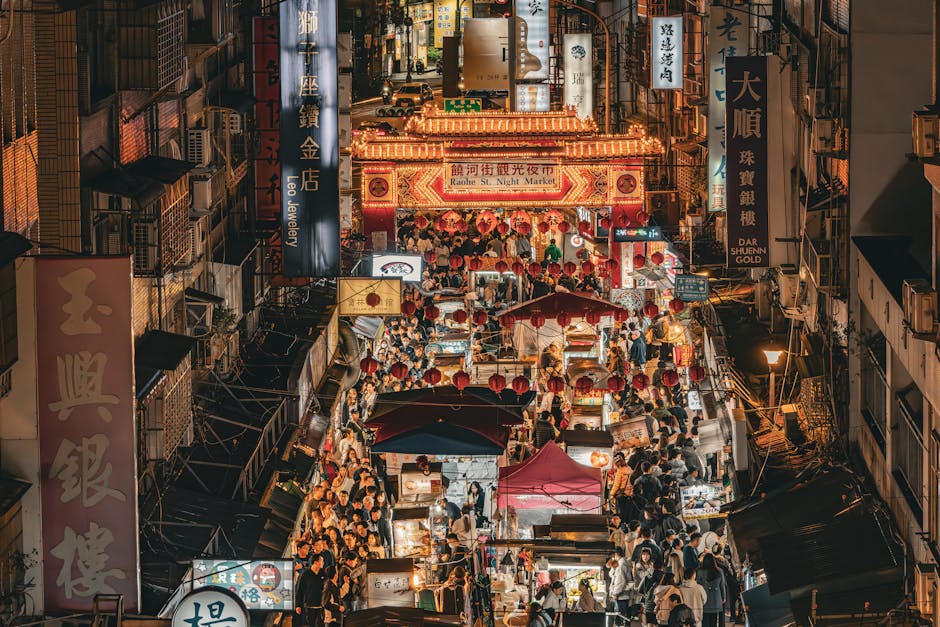
The Anti-Club
At 9 PM on a Friday in Taipei, roughly 30,000 people are spending their evening the same way: standing in a night market, eating something on a stick, and talking to the person next to them. Nobody checked their outfit at the door because there is no door. Nobody paid a cover charge because the entertainment is the crowd itself, plus the spectacle of watching a man turn a block of ice into shaved snow at a speed that suggests either decades of practice or a profound indifference to his fingers. Night markets in Asian cities—Taipei, Bangkok, Seoul, Kuala Lumpur, Hong Kong, and increasingly cities like Saigon and Chiang Mai—function as the social infrastructure that nightclubs and bars claim to be but rarely deliver: genuinely public, economically accessible, multigenerational, and organized around the shared human activity of eating rather than the manufactured activity of purchasing overpriced drinks in dark rooms.
This isn't nostalgia or romanticism. Night markets are commercially sophisticated operations that generate significant revenue, employ thousands, and compete aggressively for customers. Taipei's Shilin Night Market alone draws an estimated 10 million visitors annually and generates over NT$5 billion ($155 million) in revenue. Bangkok's Jodd Fairs, which opened in 2022 on the site of the beloved Ratchada Train Market, pulls thousands nightly with a curated mix of food vendors, vintage clothing, and handmade goods. These aren't charming remnants of a pre-modern economy; they're highly adapted commercial ecosystems that outperform their air-conditioned competitors on the metric that matters most: the ability to make strangers feel comfortable spending time near each other.
Taipei: The Gold Standard
Taiwan's night market culture is the most developed in Asia, both in quality and in the degree to which it's integrated into daily life rather than existing as a tourist attraction. The island has over 300 registered night markets, and in cities like Taipei, Kaohsiung, and Tainan, they function as extensions of the domestic kitchen—places where families go not for special occasions but because it's Thursday and cooking at home sounds exhausting and there's a stall at Raohe that makes pepper buns so good they constitute a reasonable excuse not to cook.
Raohe Night Market, stretching along Raohe Street near Songshan MRT station, is where you should start and possibly where you should stay. It's a single straight street, about 600 meters long, which means navigation is simple and the quality control is fierce—stalls that don't maintain their standards get replaced quickly because the competition is literally next door. The pepper bun stall (Fuzhou Shizu Hujiao Bing) at the entrance has had a line since the market opened in 1987. Each bun costs NT$60 ($1.85): a pork filling seasoned with black pepper and spring onion, encased in dough that's slapped against the inside wall of a clay oven and baked until the crust blisters and cracks. You eat it standing, burning your tongue on the first bite because waiting is not something the bun's architecture supports, and the pork juice runs down your wrist. This is NT$60 well spent.
Further into Raohe, the essential stops include the stinky tofu at a stall halfway down on the left (you'll find it by smell before sight), the medicinal herbal soup stall that serves pork rib soup with Chinese herbs for NT$80, and the flame-torched beef cubes at a stall near the Ciyou Temple end that costs NT$100 and delivers a beef experience that sits somewhere between street food and steakhouse. The dessert game at Raohe is equally strong: tangyuan (glutinous rice balls in sweet ginger soup) for NT$50, mango shaved ice in summer for NT$80, and peanut ice cream rolls—two scoops of peanut-shaving-studded ice cream wrapped in a thin crepe with cilantro—for NT$40 from a cart that moves positions nightly like it's evading the authorities.
Beyond Raohe
Ningxia Night Market, in the Datong district near Zhongshan MRT, is smaller, less touristed, and arguably stronger on food quality because its reputation depends entirely on the eating rather than the atmosphere. The taro balls, the oyster omelette at Lai Ji, and the lu rou fan (braised pork rice) at one of three competing stalls—I won't say which because the argument would start a war—are all among the best versions of their respective dishes in Taipei. Shilin is the largest and most famous night market, but it's also the most tourist-oriented, with a food court basement that feels institutional compared to the street-level chaos. Go to Shilin for the experience, go to Raohe for the food, and go to Ningxia when you want to eat like someone who actually lives in Taipei.
Bangkok: The Evolution
Bangkok's night market scene has undergone radical transformation in the past five years, shifting from traditional wet markets with food stalls to curated, designed spaces that blur the line between night market and outdoor mall. The original Rot Fai (Train) Market, with its vintage goods and converted railway carriages, established the template that newer markets have iterated on. Jodd Fairs, on Rama 9 Road near the MRT station, is the current king: a sprawling complex of food stalls, bars, vintage shops, and live music stages that draws a young, Thai-majority crowd on weeknights and a tourist-heavy crowd on weekends.
The food at Jodd Fairs is excellent by any standard. The seafood section—where vendors grill enormous prawns, scallops, and crab over charcoal—is theatrical and delicious, with a plate of grilled river prawns running ฿200-400 ($5.70-$11.40) depending on size. The moo ping (grilled pork skewers) at multiple stalls costs ฿10 ($0.30) per stick and is the platonic ideal of street food: sweet, smoky, salty, and impossible to eat fewer than four. The pad thai vendors compete with enough ferocity that quality stays high and prices stay low at ฿50-80 ($1.40-$2.30) per plate. The drinks section offers everything from fresh coconut water to Thai craft beer to extremely aggressive cocktails in plastic bags, because Bangkok has never met a drink that couldn't be served in a bag.
The Social Architecture
What makes night markets function as social spaces—rather than simply as outdoor food courts—is their architecture of proximity. You're standing close to strangers by necessity, because the aisles are narrow and the stalls are small and everyone is trying to navigate toward the same grilled squid vendor. This forced proximity, which would feel threatening or uncomfortable in many contexts, is defused by the shared activity of eating and by the absence of the social hierarchies that nightlife venues typically enforce. There's no VIP section at Raohe Night Market. Nobody at Jodd Fairs is being judged for wearing flip-flops. The currency of night market social interaction is the recommendation—"try the stall on the left, the one on the right uses too much MSG"—and this exchange, repeated thousands of times per evening, creates a fabric of social connection that bars and clubs, for all their stated goals of bringing people together, rarely achieve.
The multigenerational aspect matters too. Night markets are one of the few nighttime social spaces in any culture where grandparents, parents, and children coexist comfortably. A family with a stroller can navigate Raohe at 10 PM without feeling out of place. A group of teenagers eating chicken cutlets next to a retired couple sharing a bowl of mee sua isn't jarring; it's the entire point. This intergenerational mixing is something that designed nightlife spaces have never figured out and probably can't, because the economics of bars and clubs depend on targeting specific demographics, while the economics of night markets depend on serving everyone.
Night markets aren't going anywhere. If anything, they're expanding—new markets open annually in cities across Asia, the food quality keeps climbing, and younger generations are embracing night market culture with an enthusiasm that suggests it addresses something that their alternatives don't. The best night out in most Asian cities doesn't require a reservation, a dress code, or a budget larger than $15. It requires comfortable shoes, a willingness to point at things you can't identify and eat them anyway, and the understanding that the best social spaces are the ones that were never designed to be social spaces at all.