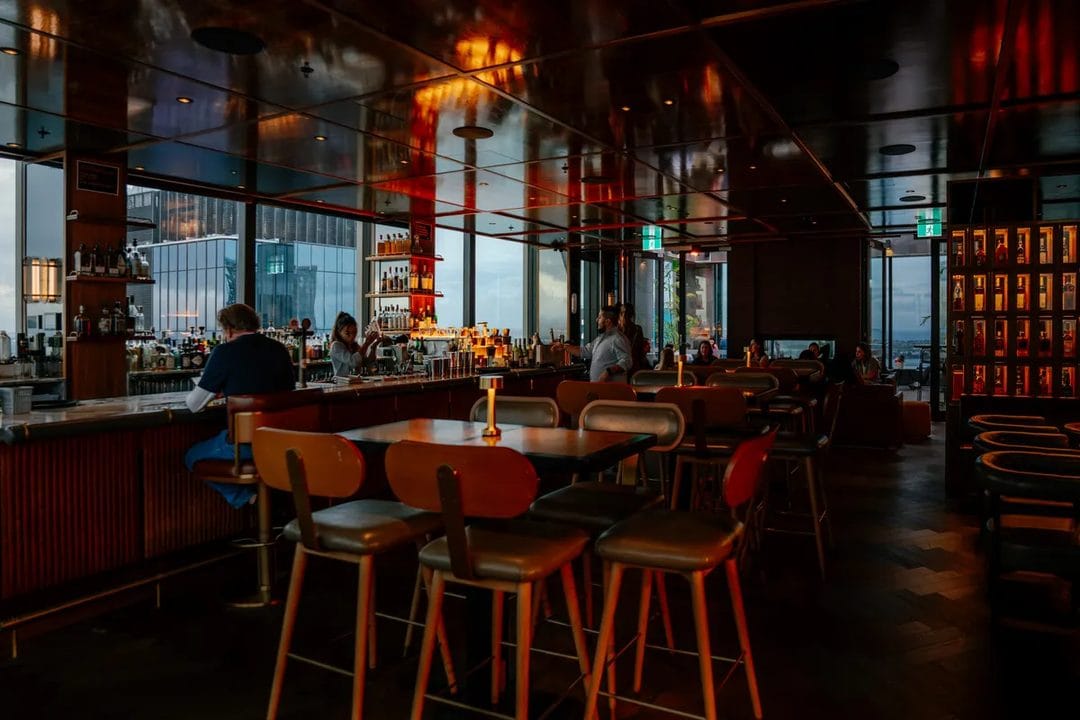
Sky Bar on the 63rd floor of Bangkok's Lebua State Tower does not sit on a rooftop terrace built for drinking. It sits on a helipad. Thai building regulations require any structure over 23 storeys to keep a working helicopter landing pad on the roof for emergency evacuation, and rather than leave that circular concrete slab empty 364 nights a year, Lebua wrapped a bar around it in 2003. Guests sip mixed drinks a few metres from the painted landing markings, most of them never realising the deck beneath their feet has a legal function that has nothing to do with cocktails. The result is one of the most Instagrammed views in Southeast Asia, built entirely on top of a rule nobody designed with tourism in mind.
That accident of urban planning turned out to be the founding story of an entire category. Twenty years later, rooftop bars are not a novelty add-on for luxury hotels in Asia's biggest cities — they are a measurable slice of the hospitality economy, with their own supply chains, their own real-estate premiums, and their own repeat-customer logic that has almost nothing to do with the cocktails themselves.
The helipad loophole that built Bangkok's skyline brand
Bangkok's rooftop scene did not happen because developers wanted to sell views. It happened because the Building Control Act B.E. 2522 mandates fire-rescue access on tall structures, and hotel groups noticed that a helipad is, structurally, just a flat open deck with a 360-degree sightline. Vertigo and Moon Bar at the Banyan Tree, on the 61st floor, opened a year before Sky Bar and made the same calculation. Both bars still function as emergency landing zones — staff can clear furniture within minutes if a helicopter needs the pad — but for 99% of their operating hours, that regulatory requirement is a paying business.
The economics are specific enough to check against a receipt. A single cocktail at Sky Bar runs roughly 450 to 550 baht (about $13 to $16), against 150 to 250 baht for the same drink at street level in Sukhumvit. Guests are effectively paying a $10 premium for altitude and a dress code — smart casual, no flip-flops, no shorts, enforced at the elevator bank before you ever reach the 63rd floor. Add a taxi across town during rush hour and the total cost of one rooftop cocktail can rival a sit-down dinner elsewhere in the city, and regular visitors know it going in. Lebua doesn't apologise for the markup, and it shouldn't: the view over the Chao Phraya at sunset is the product, and altitude is expensive to build.
Hong Kong sells vertigo, not sunset
Nobody in Hong Kong is selling you a sunset.
Hong Kong took the same infrastructure and sold a different feeling. Ozone, on the 118th floor of the Ritz-Carlton in the International Commerce Centre, held the record for highest bar in the world for most of the 2010s, and it markets itself on vertigo rather than romance — floor-to-ceiling glass, a bar counter that appears to float over Victoria Harbour, and a strict no-photography-of-other-guests policy that keeps the experience feeling private despite 300-plus covers a night. A round of drinks there lands around HK$150 to HK$220 (roughly $19 to $28), noticeably steeper than Bangkok, which tracks with Hong Kong's general cost of living but also with a simpler fact: there is only one building in the territory tall enough to offer that specific view, so Ozone doesn't compete on price.
Buildings Department fire codes in Hong Kong are stricter than Bangkok's when it comes to assembly occupancy at height — sprinkler coverage, a second independent staircase, and capacity caps tied to exit-width calculations all apply before a rooftop venue can legally seat more than a token handful of guests. That's the quieter reason Hong Kong has far fewer true 100-metre-plus rooftop bars than Bangkok despite having more supertall towers: the compliance cost of running one is higher, so only flagship hotel properties bother.
Singapore built the category around planning law, not fire law
Singapore's version of the same story runs through the Urban Redevelopment Authority rather than a fire code. URA guidelines on rooftop and terrace use in the Central Business District effectively capped how much of a building's roof plate could be commercialised for years, which is part of why CÉ LA VI on the 57th floor of Marina Bay Sands — built into the resort's iconic SkyPark rather than a standalone tower roof — became the city's reference point instead of a scattering of smaller venues. A cocktail there runs S$28 to S$32 (about $21 to $24), and the venue takes reservations by the week during peak tourist season, not the day.
1-Altitude, on the other hand, spent years marketing itself as the world's highest alfresco bar before losing that title to newer towers in Dubai and Bangkok — a reminder that "highest" is not a permanent asset in this category, only a temporary one that resets every time a taller building tops out. Smart operators in Singapore have mostly stopped competing on altitude and started competing on curation instead: Smoke & Mirrors, on the rooftop of the National Gallery, trades height for a view of the Padang and the colonial civic district, and charges accordingly less because it isn't selling a record.
What the three cities actually sell
- Bangkok sells a sunset and a dress-code moment — the helipad framing is part of the story, not hidden from it.
- Hong Kong sells scarcity and vertigo, because only a handful of buildings in the territory can legally host the experience at all.
- Singapore has quietly shifted from selling altitude to selling curation, since the "world's highest" title keeps moving to whichever city just finished a taller tower.
None of this works without staff who understand the regulatory tightrope they're operating on. A rooftop bar manager in Bangkok has to know exactly how fast a helipad needs to be cleared, on paper, even if it has never happened during their shift.
The dress code is doing more work than the drinks list
Ask a concierge in any of these three cities where to send first-time visitors and you'll get Sky Bar, Ozone, or CÉ LA VI almost every time — not because the cocktails are exceptional, but because the dress code and reservation friction do something a cheaper bar can't: they make the evening feel earned. Smart casual minimums, no-sneaker policies, and minimum-spend requirements at the door (commonly $30 to $50 per person at the marquee venues) filter for guests who have already decided this is an event, not a stop on a bar crawl. You are not paying for gin and tonic; you are paying for the two hours of anticipation that started when you checked the dress code before leaving your hotel room.
The cost side of that equation is unglamorous but real. Wind load on an exposed 60th-floor terrace destroys outdoor furniture and umbrella fabric within 18 months in Bangkok's monsoon season, according to maintenance contracts hotel groups have disclosed to regional trade press, and every glass panel replaced at height requires a suspended scaffold rig that costs multiples of ground-floor glazing work. Air-conditioning is largely irrelevant — most of these venues are semi-open or fully alfresco — but structural wind bracing, lightning protection, and helicopter-pad certification renewals are recurring line items that a street-level bar simply does not carry.
What doesn't survive the model
Not every rooftop bet pays off. Several mid-tier Bangkok hotels added rooftop bars during the 2012–2015 boom expecting Sky Bar-level traffic and folded the concept within three years once it became clear that view alone, without the brand recognition of a Lebua or a Banyan Tree, doesn't generate return visits. A rooftop bar with an unremarkable skyline angle and no dress-code theatre is just an expensive outdoor bar with worse Wi-Fi than the lobby lounge below it. If you're scouting a rooftop for a first visit in any of these cities, skip anything below floor 40 unless the neighbourhood view is genuinely distinctive — the marginal height between floor 25 and floor 60 is where the photograph actually changes.
The category is still expanding, though the growth has shifted from record-chasing to neighbourhood-specific storytelling — Kuala Lumpur's Skybar at Traders Hotel and Shanghai's Vue Bar have both taken the Bangkok playbook and localised it around their own skylines rather than trying to out-height Hong Kong. What started as a workaround for a fire-safety rule on one Bangkok tower two decades ago is now a template that any city with a cluster of supertall buildings and a half-decent view can run, provided someone is willing to pay for the wind bracing.